See who owns a process, what it depends on and what a change will affect
In your words: “We cannot quickly see who owns a process, what it depends on or what a change will affect”
- Process architecture
- Operating model visibility
- Change impact analysis
Processes, roles, systems, risks and controls may be recorded but cannot be interrogated as a connected model. This becomes most visible when decisions must cross functions, systems or organisational boundaries and no single owner can supply a trusted answer.
When processes, roles, systems, risks and controls sit in one connected model, basic questions take minutes instead of analyst-days. Ownership, dependencies and impact can be seen together.
Changes account for their dependencies, incidents are understood faster and executive decisions are made with the whole picture in view.
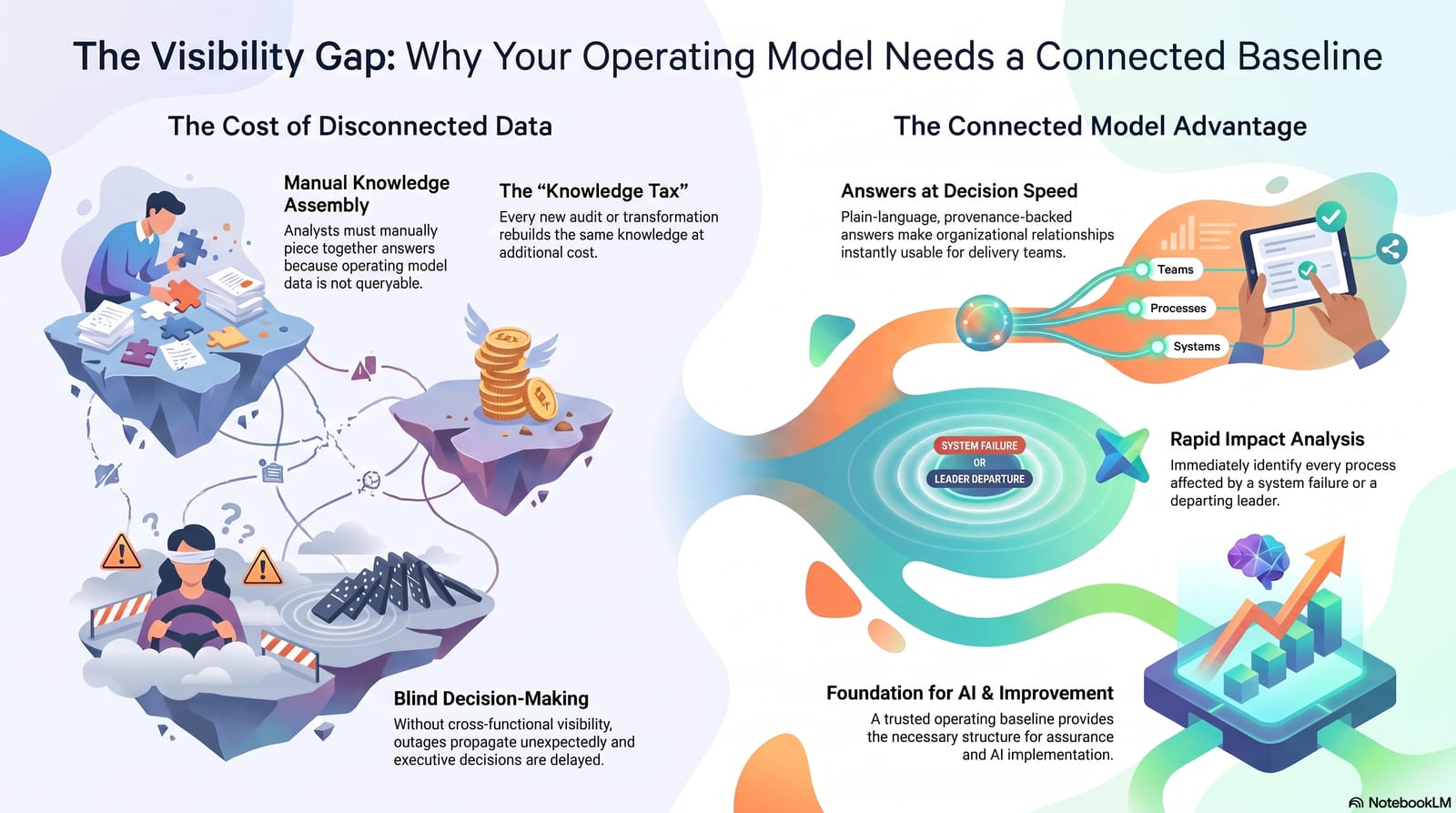
Plain-language, provenance-backed answers make organisational relationships usable at decision speed. In practical terms, leaders and delivery teams can work from the same baseline, interrogate relationships quickly and govern updates as the organisation changes.
- Faster impact analysis; fewer missed dependencies; better-informed change, incident and investment decisions
- A trusted operating baseline
- Faster ownership and impact analysis
- Less duplicate discovery and reconciliation
- Stronger foundations for improvement, assurance and AI
- If a system failed tomorrow, could you identify every affected process?
- Can you identify every process owned by a departing leader?
- How long does impact analysis take today?
- Which executive decision currently takes too long because operating-model evidence must be assembled manually?
- What governance event causes the process baseline to be reviewed and updated?
APQC highlights end-to-end ownership, accountability, control and measurement as foundations for managing work across functional boundaries.
APQC: Applying Governance and Roles to End-to-End Processes
APQC defines end-to-end processes as cross-functional work connecting all steps required to achieve a shared outcome, rather than a collection of functional activities.
APQC: End-to-End Processes