Why Your Company Keeps Flying Blind
Processes, roles, systems, risks and controls are usually all recorded somewhere. That is not the same as being able to interrogate them as a connected model. This episode covers why that gap only becomes visible when a decision has to cross a functional boundary, what the resulting 'memory wipe' costs an enterprise in duplicate discovery, and what a provenance-backed, queryable operating model replaces it with.
Episodes feature AI-generated hosts discussing human-written IGX360 research.
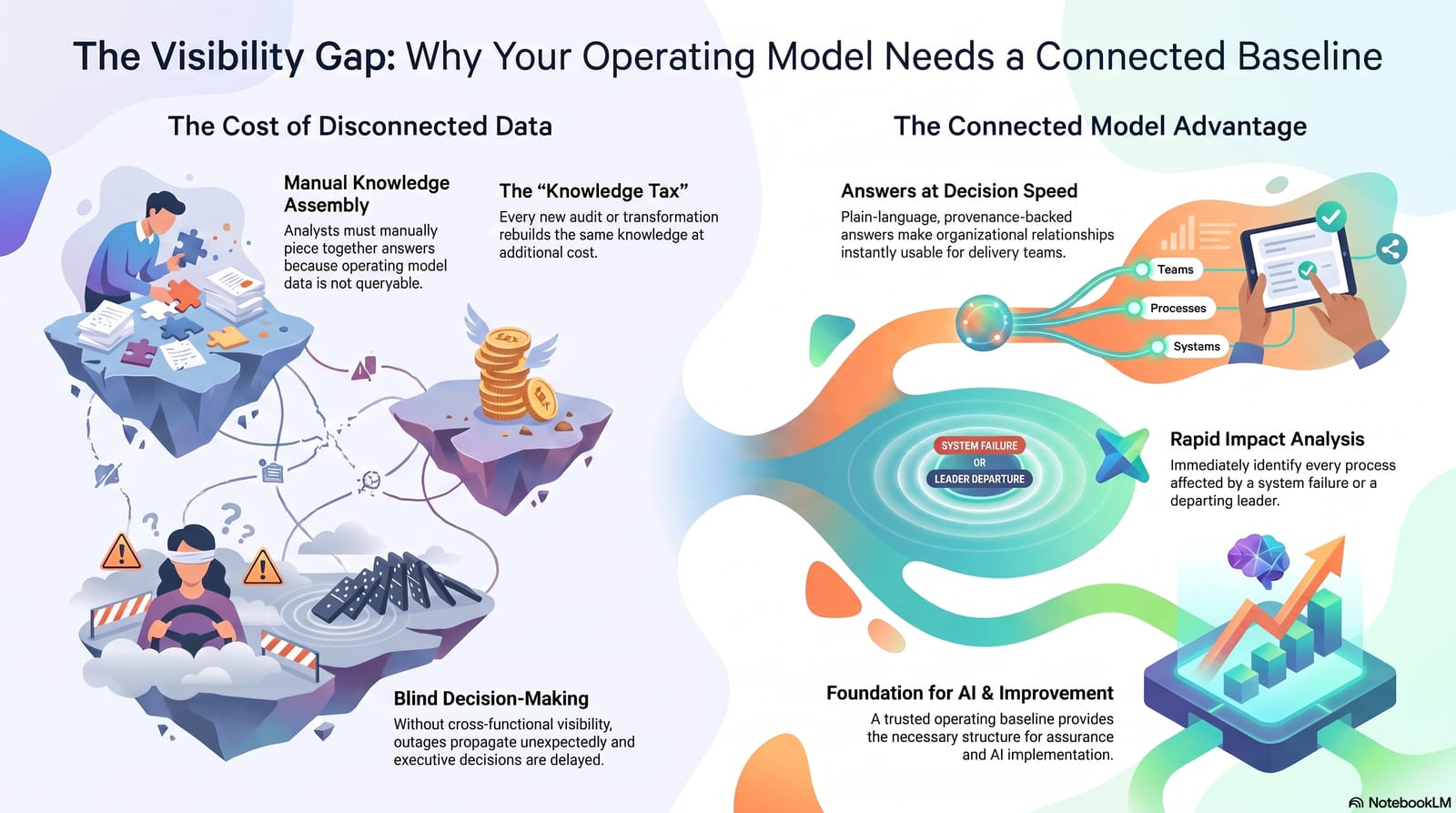
Every process, role, system, risk and control might be recorded somewhere. That is not the same as being able to interrogate them as a connected model, and the gap between the two stays invisible until a decision has to cross a functional boundary and no single owner can supply a trusted answer.
This episode walks through why static documentation creates an illusion of safety rather than operational truth, what a recurring organisational “memory wipe” costs an enterprise every time the same dependency map gets rebuilt from scratch, and how shifting from flat files to a relational, provenance-backed model gets leaders and delivery teams working from one queryable baseline at decision speed.
Read the full transcript
Host: Picture this, you're sitting at your desk, it's a Tuesday morning, you've got your coffee in hand, and suddenly, like out of nowhere, a completely unexpected company-wide alarm goes off.
Co-host: The classic Tuesday morning crisis.
Host: Right, exactly. A critical backend system just completely failed. Or maybe it's not even a system. Maybe a really key vice president just handed in their two weeks' notice, totally out of the blue.
Co-host: Which can honestly be worse than a server going down.
Host: Yeah, exactly.
Co-host: And the absolute panic that sets in there, it isn't just because the technology broke or because that leader is leaving. I mean, it's bad.
Host: But the real nightmare is that nobody in the entire building actually knows what breaks downstream.
Co-host: Yep, nobody knows what's attached to that person or that system.
Host: Exactly.
Co-host: You look around and you suddenly realize your entire organization is flying completely blind.
Host: It's a terrifying moment.
Co-host: And the crazy part is it happens every single day in corporate environments all around the world.
Host: I mean, we build these massively complex enterprise architectures, but the second one little thread is pulled...
Co-host: The whole tapestry unravels.
Host: Exactly.
Co-host: It just unravels in the dark.
Host: Well, that corporate nightmare is our focus for today's deep dive.
Co-host: We're looking at a really fascinating internal strategy document today, and it's titled...
Host: P3: We Cannot See Ownership, Dependencies, or Change Impact.
Co-host: Catchy title, right, gets right to the point.
Host: It really does.
Co-host: It's built around the SIPIN framework, which is...
Host: Situation, problem, implication, need, payoff.
Co-host: And our mission today is basically to decode why organizations constantly suffer from this blind decision-making.
Host: Right, and why vital business knowledge just gets perpetually rebuilt from scratch.
Co-host: Yes, and understand the actual mechanics of how transitioning to a connected operating model can actually solve this chaos.
Host: Because to solve the chaos, we first have to really understand the trap most companies are in.
Co-host: And the strategy document points out a huge paradox here. It is not, it's not a lack of documentation.
Host: Really? Because you'd think they just aren't writing things down.
Co-host: You would think that. But no, companies do record their processes and their roles, their systems, their risks, their controls. I mean, they have absolute mountains of data.
Host: So the issue isn't that people are just, you know, being lazy and failing to keep records. The documentation actually exists.
Co-host: It totally exists, but it creates this illusion of safety. The fundamental problem is that all these records, they cannot be interrogated as a connected model.
Host: I mean, they're just kind of sitting there.
Co-host: Exactly. They're entirely static.
Host: So a business process is mapped out in a Visio file, right, and that's sitting on some random SharePoint drive.
Co-host: But then the risk controls are in this giant Excel spreadsheet managed by the compliance team, and the IT systems, those are cataloged in a completely separate configuration database, like ServiceNow or something.
Host: So they are basically living in completely different universes.
Co-host: Totally different universes. And this becomes just painfully obvious the very moment a business decision has to cross a functional boundary.
Host: Which is, I mean, almost every major decision.
Co-host: Right, exactly. When you have to cross into a different system or an organizational line, there is literally no single owner who can supply a trusted, comprehensive answer.
Host: Okay, this reminds me of, let me try this analogy. It's like having a perfectly cataloged kitchen, but the recipe, the ingredients, and the actual chef are all stored in completely different buildings.
Co-host: Oh, that's good.
Host: Like sure, you theoretically have everything written down, you have the inventory, but you can't actually cook a meal because you can't put them together when you need them.
Co-host: That analogy is spot on. And it perfectly captures the sheer frustration of the analysts on the ground. Because when the pressure is on, when a system fails or an audit drops, basic questions suddenly require these analysts to just assemble answers manually.
Host: Piece by agonizing piece.
Co-host: Yes, they are basically forced to act as human search engines across all those disconnected silos.
Host: They're running between the buildings in your kitchen analogy.
Co-host: And the underlying weakness there is just the total absence of a governed, connected, and queryable representation of the operating model.
Host: Okay, but let me play devil's advocate for a minute here. Because if I am an executive, right, and I'm looking at my budget, I might question the actual severity of this. Like, we pay analysts to analyze. So it takes an analyst, say, three days, to manually build a dependency map in a PowerPoint presentation. Is that really a massive crisis? It kind of just sounds like standard corporate overhead, a minor bureaucratic inconvenience.
Co-host: Well, okay, if we only look at one single isolated incident, yeah, it might just look like a minor inconvenience, a few days lost. But the source text outlines the implications of this disconnected model at an enterprise scale, and when you zoom out, the fallout is honestly devastating. Because dependency maps take three days, or sometimes three weeks, to build manually, change constantly misses hidden dependencies.
Host: Oh, so things slip through the cracks while they're building the slide deck.
Co-host: Exactly. Outages propagate unexpectedly. And those critical executive decisions you mentioned, they are either significantly delayed while the board sits around waiting for that PowerPoint, or worse, they just guess.
Host: They guess.
Co-host: The window of opportunity closes and the decisions are made completely blind.
Host: Wow. So it's like pulling a massive lever in a factory without actually knowing what that lever is attached to on the other side of the wall.
Co-host: That is exactly what it's like. And it actually goes deeper than just the immediate risk of making a bad blind decision. The document introduces this concept that we really need to linger on: the sheer enterprise-scale cost of what is essentially a recurring organizational memory wipe.
Host: A memory wipe, that sounds intense.
Co-host: It is. Every single time there's a new change, a new audit, a new incident, or a major transformation program, the organization has to rebuild the exact same knowledge entirely from scratch.
Host: Okay, let's build a scenario around this so the listeners can really see the mechanics of that memory wipe in action.
Co-host: Okay, let's do it.
Host: So let's say an analyst maps out the entire order-to-cash process for a really big compliance audit in, say, January. They spend three weeks doing this, interviewing stakeholders, pulling data from IT, checking compliance logs. They finish the massive map, the audit goes well, and the resulting document is saved as a PDF on a shared drive.
Co-host: Yep, and that PDF is completely static. It is not fed back into any living connected system. It's basically a tombstone for that data.
Host: A tombstone, exactly. So roll the clock forward to July, a brand new chief operating officer comes in. They always want to change things.
Co-host: Always.
Host: Yeah. And they want to launch a massive digital transformation program that touches those exact same order-to-cash systems. But that analyst from January, they've moved to a different department, or maybe they left the company.
Co-host: What happens next?
Host: Well, a completely different analyst gets assigned to figure out the dependencies for the new COO. And they don't update that January map.
Co-host: They probably don't even know it exists. They have no idea it's on that SharePoint drive.
Host: Exactly. So they start from zero. They conduct the exact same stakeholder interviews. They dig through the exact same disconnected systems all over again.
Co-host: So the company is literally paying for the discovery phase all over again.
Host: Exactly. It's the exact same work, simply because the knowledge wasn't stored in a way that anyone could actually query it. You were just bleeding capital and resources just to figure out where you stand before you even take a single step forward to actually execute the transformation.
Co-host: That's wild. This constant duplicate discovery and reconciliation is just a staggering drain on the business.
Host: Okay, so if that disconnected memory-wipe model is the trap, which it clearly is, how do we architect the escape? Like, what does the exact opposite look like?
Co-host: Well, the text points toward a very specific solution. It's kind of framed as a holy grail for the operating model. And it requires what they call plain-language, provenance-backed answers that can operate at decision speed.
Host: Okay, there are a couple of heavy terms in there. Let's start with provenance-backed. That feels like the technical linchpin here.
Co-host: It really is. Provenance-backed means you aren't just getting an answer, you are getting the entire lineage of that data.
Host: Okay, so you know its history.
Co-host: Right, you know exactly where the data came from, who specifically owns it, and the exact timestamp of its last update.
Host: But how does that actually work under the hood? Like physically, how does data become provenance-backed in a way that solves that static PDF problem we were just talking about?
Co-host: Well, it requires fundamentally shifting from flat files, like your PDFs and Visio diagrams, to a relational, object-based architecture.
Host: Object-based architecture.
Co-host: Yes. So instead of just typing the words 'CRM system' as flat text on a drawing, the CRM system becomes a distinct data object within a governed central repository.
Host: So it has its own identity in the database.
Co-host: Exactly. And that system object is digitally linked to a business process object, which is then linked to a specific role object, say the VP of sales.
Host: I see. So because they are linked, they inherit properties from one another.
Co-host: Precisely. They inherit those properties. So if the IT department flags that CRM system object and says, hey, this is scheduled for deprecation in 90 days, that update just cascades through all the relationships automatically.
Host: Yes.
Co-host: Any business process that relies on that CRM instantly shows a dependency warning. The VP of sales gets automatically notified. The provenance is literally built into the architecture.
Host: So your leaders and your delivery teams are finally working from the exact same dynamic baseline. Wow. I mean, that completely changes the dynamic of a high-stakes meeting. The phrase 'decision speed' really jumped out at me in the source text.
Co-host: It's a powerful concept.
Host: It really is. Like, I want you to imagine being in a boardroom where a major strategic pivot is on the table. Usually someone asks a critical 'what if' question about a downstream impact, right? What happens if we pull this plug?
Co-host: Exactly. And the whole room just deflates.
Host: Someone sighs, they take an action item, and you basically lose a week waiting for the answer.
Co-host: A week if you're lucky.
Host: Right. But getting an answer at decision speed, that means having a plain-language answer right then and there in the room.
Co-host: It's not just about getting the right answer, it's about getting it before the window of opportunity actually closes. It empowers real agility.
Host: And that's exactly it.
Co-host: The speed of the trusted answer dictates the agility of the entire business. The benefits indicated in the document map directly to this architectural shift. I mean, you get massively faster impact analysis. You virtually eliminate those missed dependencies because the relationships are mathematically mapped in the system, they aren't just guessed at on a whiteboard. And you enable way better-informed decisions across the board, whether that's for routine system change, an emergency incident response, or allocating a multimillion-dollar investment.
Host: Okay, but to ground this in reality for a second, the document also brings in an external benchmarking standard. It mentions APQC. And I think it's really important to note for you listening that this isn't just some theoretical corporate fantasy that someone dreamed up.
Co-host: No, not at all. This methodology aligns with really established best practices for process and performance management. APQC serves as a really vital external validation point here. They highlight that end-to-end ownership, accountability, control and measurement are the absolute fundamental foundations for managing work across functional boundaries.
Host: But their specific definition of end-to-end processes is where the operational philosophy really shifts, right? Because the text contrasts true end-to-end processes against what it calls 'a collection of functional activities.'
Co-host: Yes, and that distinction is everything.
Host: How so?
Co-host: Well, a collection of functional activities is essentially just a siloed to-do list. And the psychology of a to-do list is highly, highly localized, meaning people only care about their little piece of the puzzle.
Host: Exactly. The IT department upgraded the server, cool, they checked their box. Marketing launched the campaign email, they checked their box. Legal reviewed the compliance terms, box checked.
Co-host: Everyone did their specific functional activity. But nobody's actually responsible for making sure the customer received the product on time and without errors.
Host: Like, everyone did their job, but the overall operation still failed.
Co-host: Because nobody was looking at the spaces between the boxes.
Host: Oh, I like that. The spaces between the boxes.
Co-host: Yeah. APQC defines true end-to-end processes as cross-functional work, connecting all steps required to achieve a shared outcome.
Host: Connecting all steps. So how does the connected operating model actually physically force that kind of alignment? Because you can't just tell people to care more.
Co-host: No, you can't. You have to force it by making the handoffs completely visible. In a disconnected model, IT just doesn't see what marketing does with the server, it's not their problem. But in a connected relational model, that dependency is mapped and visible to everyone in the system.
Host: You cannot just check your box and walk away because the system shows you your exact dependency on the person before you and the person after you.
Co-host: It connects you. It forces the psychology of the organization to shift from 'did I complete my task' to 'did we actually achieve our shared outcome.' It really elevates the whole mindset because the architecture finally supports a unified view.
Host: Okay, so we understand the trap of those static PDF documents. We see the enterprise cost of the constant memory wipe. We understand the relational architecture of the solution, and how that lines up with true end-to-end alignment from APQC. But how does the listener actually test the health of their own organization today?
Co-host: Like right now, the source text provides a series of discovery questions that essentially act as a stress test.
Host: Yes, and these questions are brilliant. They are designed to instantly reveal if an organization is operating in the dark.
Co-host: Okay, lay them on us.
Host: So the first one takes us right back to our opening scenario. If a system failed tomorrow, could you identify every single affected process? Just off the top of your head.
Co-host: And honestly, I would wager most people listening know their company would really struggle to answer that confidently without days of digging.
Host: Oh, absolutely. And then the next question is basically the ultimate litmus test for ownership. Can you identify every process owned by a departing leader?
Co-host: I really want you to visualize this one. Think of a key vice president in your company right now, someone who runs regional operations or enterprise sales.
Host: If they walk into human resources tomorrow morning and just unexpectedly resign, what actually happens?
Co-host: Total chaos. Does your company have a queryable map showing every single process, every risk and every system that specific VP owned? Or is all of that critical business knowledge just locked inside that one person's head, or buried in personal Excel spreadsheets saved on their local C drive?
Host: Exactly. If they leave the building, does an entire department suddenly fly blind?
Co-host: In a disconnected model, the organization usually has a really hard realization right then and there. They realize they don't actually own their process knowledge, the parting VP owned it. They just rented it from them.
Host: Ouch, that is a rough realization. What are the other discovery questions?
Co-host: The rest of them really poke at the daily symptoms of this disconnect. They ask things like, how long does impact analysis take today?
Host: Right, the three-day PowerPoint problem.
Co-host: Yep. And which executive decision currently takes way too long because the operating model evidence has to be assembled manually? And there's a crucial one in there regarding governance too: what governance event causes the process baseline to be reviewed and updated?
Host: Right, and that question exposes whether your governance is proactive or entirely reactive. Like, do you only update the map when the building is on fire?
Co-host: Exactly. Does your baseline only get updated when something violently breaks in production, or when an external auditor forces you to scramble? Or, in a perfect world, is the baseline a living, breathing model that updates organically as the business itself changes?
Host: And the document doesn't just leave us with these really uncomfortable questions.
Co-host: Thankfully.
Host: Right, it actually presents a clear call to action to test these questions live. And it mentions specific technical products designed to transition a company away from all this manual chaos. It specifically points to something called IGX360 Insights and another tool called Iggy.
Co-host: Yes, and these tools essentially mechanize the exact relational architecture we were discussing earlier. So IGX360 Insights, that acts as the governed, connected repository. It is the underlying engine mapping all those objects, the roles, the systems, the processes, and it continually interrogates their relationships.
Host: And what about Iggy? What role does that play?
Co-host: Iggy is really cool. It serves as the interface for that plain-language requirement we talked about.
Host: Oh, right, because not everyone is a database engineer.
Co-host: Exactly. Instead of an executive having to write complex database queries just to find a dependency, Iggy allows users to ask a simple plain-language question.
Host: Just type it in.
Co-host: Just type it in. You literally ask what processes are impacted if we decommission this legacy software next month.
Host: Wow.
Co-host: The tool queries the connected IGX360 model and returns a provenance-backed answer at decision speed. It totally bridges the gap between complex architectural mapping and intuitive daily business use.
Host: Which effectively removes that whole human-search-engine workload from the analysts.
Co-host: Exactly. They can get back to actually analyzing.
Host: That's amazing. Well, we have covered a massive amount of ground here today. We started by tearing down the illusion that having static documentation is somehow the same as having a connected operating model.
Co-host: A very common trap.
Host: Right. And then we explored the devastating enterprise cost of that perpetual memory wipe, where analysts are forced to duplicate discovery phases over and over again.
Co-host: Bleeding capital the whole time.
Host: And finally, we unpacked the mechanics of building a truly relational, queryable baseline, one that actually enables organizations to act at decision speed and achieve those true end-to-end shared outcomes.
Co-host: It really just represents a fundamental evolution in how a business understands its own DNA. You transition from constantly playing defense, reacting to outages and scrambling for data, to finally playing offense. You can confidently navigate change because for the first time, you actually have a real map of the territory.
Host: But before we wrap up, there is one final detail in the source text that I think demands a closer look, because it's super relevant right now.
Co-host: Oh, the AI component.
Host: Yes. The text mentions that a connected operating model provides stronger foundations for improvement, assurance, and AI. And that last piece presents a really fascinating inverse scenario that I think we just have to leave the listener with.
Co-host: It's a very provocative thought. What happens when AI meets the disconnected reality we've been talking about?
Host: I mean, every organization right now is rushing to implement artificial intelligence. It's the huge gold rush.
Co-host: Oh, totally. Everyone wants AI. But AI relies entirely on the quality and the structure of the data it is fed. It learns from the environment it lives in.
Host: So if you deploy AI over a disconnected operating model, an environment that fundamentally lacks provenance-backed answers, where dependencies are just hidden in flat PDFs and ownership is a total mystery, what are you actually architecting?
Co-host: You aren't giving the AI a map. You are basically tying a blindfold around its eyes.
Host: Exactly. You are feeding it fragmented, static illusions. And if the AI cannot see the true relational dependencies, it will make recommendations, or even worse, it will automate actions based on a totally incomplete reality.
Co-host: Which is terrifying. You won't be solving your organizational problems. You will simply be automating your blind spots and propagating unexpected downstream outages at machine speed.
Host: Automating blind spots at machine speed. Wow. That really brings us full circle to the absolute nightmare scenario we started with today, only this time it's way faster.
Co-host: Right. Only this time, when the alarms go off across the company, it isn't because a human made a slow, blind decision. It's because an algorithm made a hyper-fast blind decision, all based on an architecture that didn't actually know itself.
Host: It's definitely something to chew on before you buy that next enterprise AI tool.
Co-host: Absolutely.
Host: Well, thank you for joining us on this deep dive. We hope this exploration empowers you to look at your own operating models with a much sharper critical lens, and encourages you to keep asking the hard questions about how your organization truly connects its knowledge.
Co-host: Until next time.
Want to see what this looks like on your own BPM content? One conversation is enough to start.