Start with what you have. Know what you can stand behind.
Most process repositories capture the visible layer: diagrams, SOPs, work instructions. The intelligence lives in the relationships between them.
IGX360 Insights turns your existing process repository into queryable intelligence. Three stages. One canonical model. A direct path from the documents you hold to decisions you can defend.
What do you get from the first engagement?
The method starts with a read-out your stakeholders can use: what exists, what is connected, what is missing, and which model improvements unlock the highest-value decisions.
Sources and confidence
Which documents, repository objects, and relationship paths support each finding, and where evidence is weak or missing.
Links to add so more questions can be answered
Where ownership, controls, dependencies and policy links can be added, and where objects are duplicated.
What to model next
A prioritised set of actions for moving from documentation to a queryable canonical model.
Where you are. Where you can be. What unlocks it.
Each stage builds on the last. You replace nothing, and you build on what is already in the repository.
1
- Rich library of process documentation and diagrams
- Version-controlled SOPs and work instructions
- Structured policy and regulatory document store
- Visual process maps with swimlane detail
- Partial system and resource mapping
- Link each process to the risk that governs it
- Make the connection between policies and processes explicit
- Bring ownership into the repository
- Turn resources into queryable objects
- Ask "what depends on this system?" and get an answer
- If an auditor asks "which processes are covered by Policy X?", where does the answer live?
- If a key system goes down, which processes are impacted?
- Who owns each process, and is that data in the repository?
- How current is your documentation, and how do you know?
2
- Processes → linked to roles, systems, and outcomes
- Risks → formally associated with specific process steps
- Controls → mapped to the risks they mitigate
- Resources → systems, tools, people as typed objects
- Policies → linked to the processes they govern
- Strategic objectives → connected to executing processes
- Documents describe work. Objects model work, and can be interrogated
- Relationships make the invisible visible: dependencies, gaps, orphans
- Your existing diagrams don't change. Objects sit alongside them
- Every relationship you model is a future query you can run
- Which processes have no assigned owner?
- Which risks have no mitigating control?
- What processes depend on this system?
- Which strategic objectives have no executing process?
3
- Cross-lens scoring: a process assessed across all five dimensions simultaneously
- Gap detection: orphaned objects, missing links, unowned assets surfaced automatically
- Relationship intelligence: questions that are hard to run manually at scale
- Model maturity scoring: how complete is your repository?
- Trend analysis: how is your process health changing over time?
- "Which critical processes have no documented owner?"
- "Which risks in the procure-to-pay process have no associated control?"
- "Which processes depend on System X, and which have a continuity plan?"
- "How has our governance coverage changed since last quarter?"
- "Which strategic objectives have no supporting process yet?"
- Audit preparation: evidence at hand
- Change impact assessment: from the model
- Regulatory coverage: demonstrable
- Executive reporting: derived from the repository
- Continuous intelligence: a living view
Each stage multiplies the one before it.
You don't start over. You build on what you already have, and the value compounds as the model gets denser.
- Process maps and workflows
- SOPs and work instructions
- Policies and standards
- System and role diagrams
- Typed enterprise objects
- Process ↔ risk linkages
- Control ↔ policy mappings
- Resource dependencies
- Five analytical lenses
- Automated gap detection
- Cross-lens health scoring
- Iggy: voice & conversational queries
And then there's Iggy.
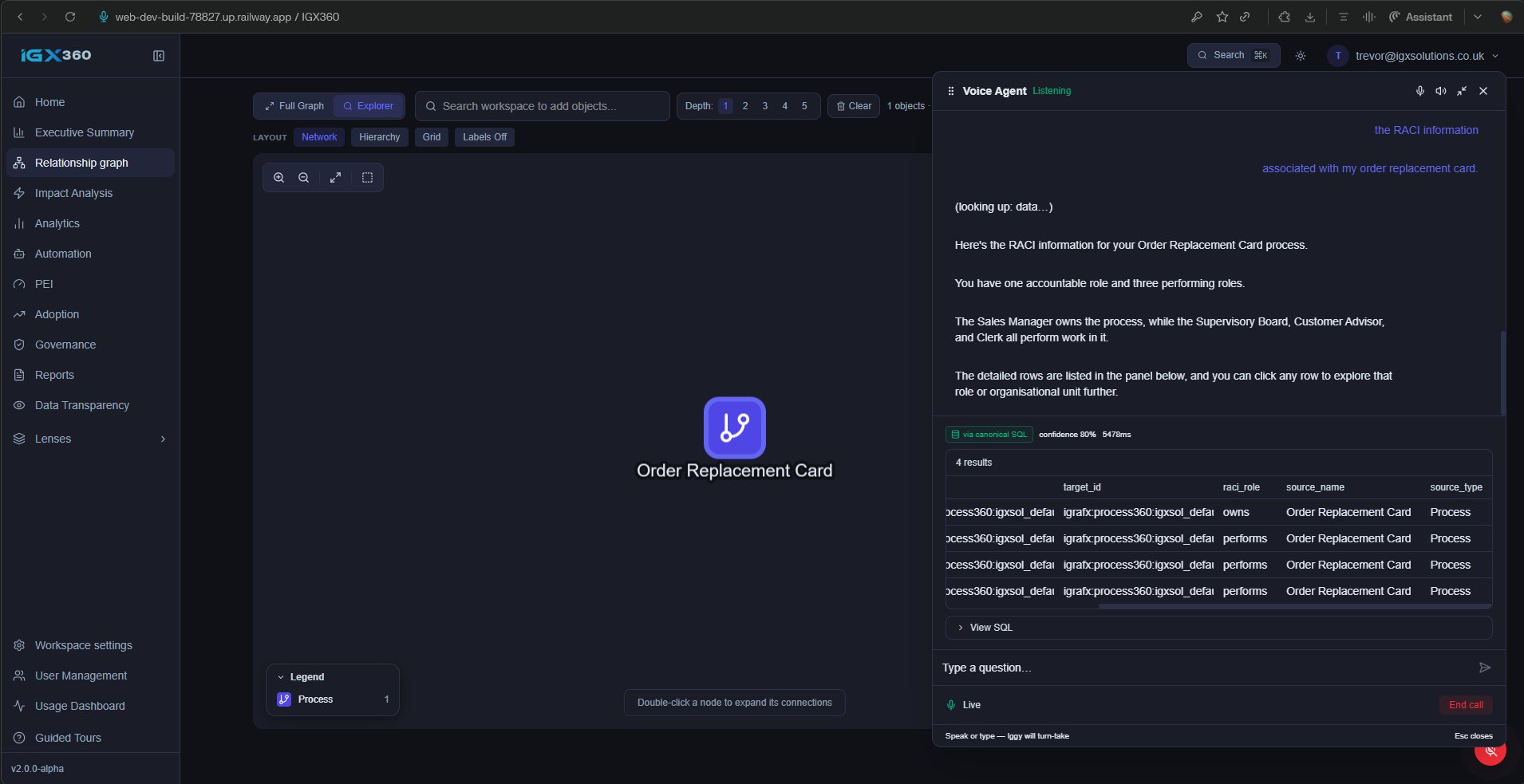
A voice and text agent that queries the canonical model directly. It explains what you're looking at, and tells you what it means.
See what your existing repository can tell you.
We will run IGX360 Insights against a representative slice of what you have (process maps, RACI matrices, system dependencies) and show you the intelligence your repository already holds.