Prove your compliance with evidence
In your words: “We think we are compliant but cannot prove it”
- Continuous compliance
- Control assurance
- Audit readiness
Policies, obligations, processes, risks and controls are maintained in separate structures or reviewed periodically. This becomes most visible when an audit, regulatory change, incident or assurance request requires the organisation to prove how an obligation operates in practice.
Traceability from obligation through process, owner, system, control and retained evidence lets you show how a duty is met, whenever you are asked.
Audit preparation shortens, gaps are found early and remediation is planned rather than rushed. Confidence with auditors and boards grows.
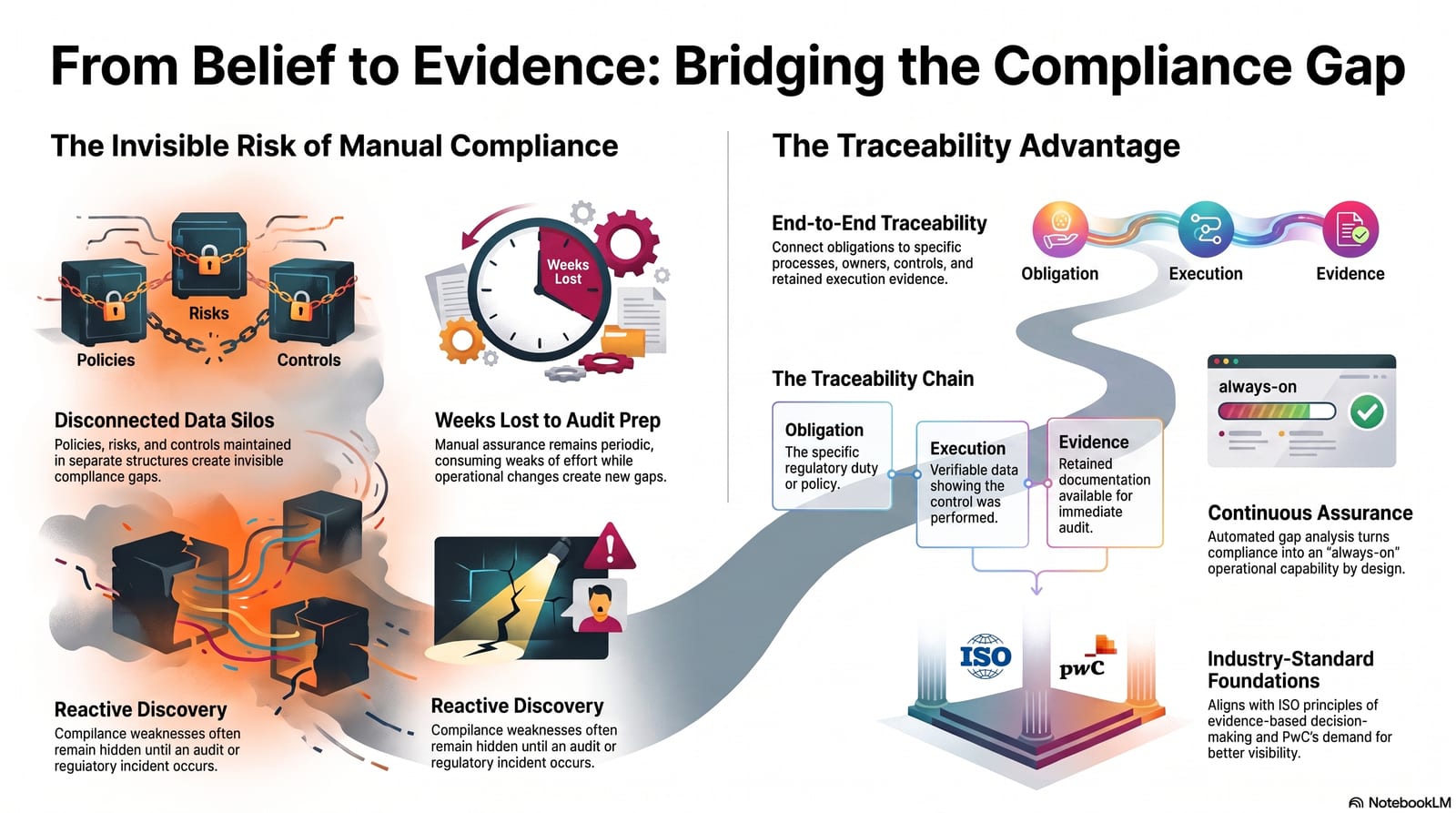
Connected controls and automated gap analysis turn assurance into a continuous capability. In practical terms, change and assurance can be managed as connected operational work, with accountable remediation and evidence available by design.
- Lower audit-preparation effort; earlier detection of gaps; clearer control ownership and evidence
- Faster regulatory impact assessment
- Earlier detection of control and evidence gaps
- Reduced audit and inspection preparation
- Defensible traceability from duty to execution
- Which obligations cannot currently be traced to a process and control?
- How much effort went into the last audit evidence pack?
- Which controls have no clear owner or verification evidence?
- Which obligation is hardest to trace to a named operational owner and control?
- What evidence would prove implementation rather than policy publication?
PwC’s survey of 1,802 executives identifies growing compliance complexity and demand for better visibility, proactive issue identification and reporting.
PwC: Global Compliance Survey 2025
ISO identifies process orientation, customer focus, evidence-based decision-making and continual improvement as foundations of effective quality management.
ISO: Quality management principles