Map where operational failure would spread
In your words: “We do not know where operational failure will spread”
- Operational resilience
- Critical service mapping
- Dependency analysis
Supplier, system, role and process dependencies are incomplete or difficult to query. This becomes most visible when a disruption crosses shared technology, suppliers, locations, workforce or service boundaries faster than impact can be understood.
An end-to-end view of critical outcomes, dependencies, concentration, substitution, controls and recovery assumptions shows where resilience is strong and where to strengthen it.
Incident response starts from a known map. Continuity plans, testing and investment focus on the dependencies that matter most, and recovery is faster.
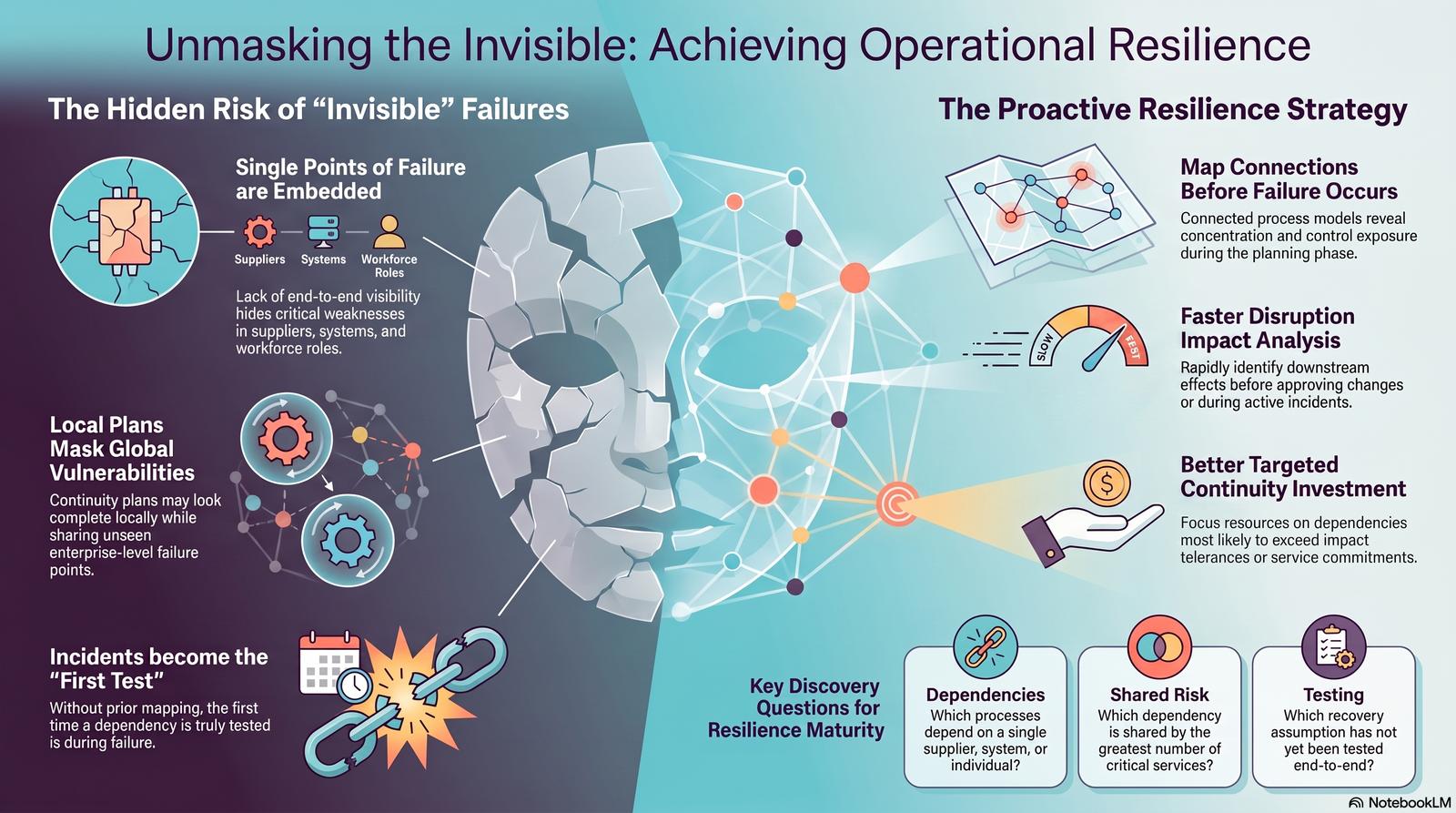
A connected process model reveals concentration, dependency and control exposure before failure. In practical terms, scenario testing and investment decisions can focus on the dependencies most capable of exceeding impact tolerances or service commitments.
- Earlier identification of concentration and failure risk; faster response and more defensible resilience planning
- Earlier visibility of concentration and single-point failures
- Faster disruption impact analysis
- Better targeted continuity and resilience investment
- More credible testing, recovery and exit evidence
- Which processes depend on one supplier, system or individual?
- Can you identify downstream impacts before approving change?
- When was the dependency model last tested?
- Which dependency is shared by the greatest number of critical services?
- Which recovery assumption has not been tested end to end?
The FCA requires in-scope firms to map important business services and remain within impact tolerances through disruption.
FCA: Operational Resilience
ISO 22301 provides a framework for identifying disruption risks, planning response and recovery, and maintaining the capability to continue priority activities.
ISO: ISO 22301 Business continuity management systems