Why You Cannot Prove You Are Compliant
Believing you are compliant and being able to prove it are two different things, and the gap between them stays invisible until an audit, regulator or incident asks the question directly. This episode covers why traceability from obligation to evidence is the real gap, what a manual audit-evidence hunt costs an enterprise, and what connected controls with automated gap analysis replace it with.
Episodes feature AI-generated hosts discussing human-written IGX360 research.
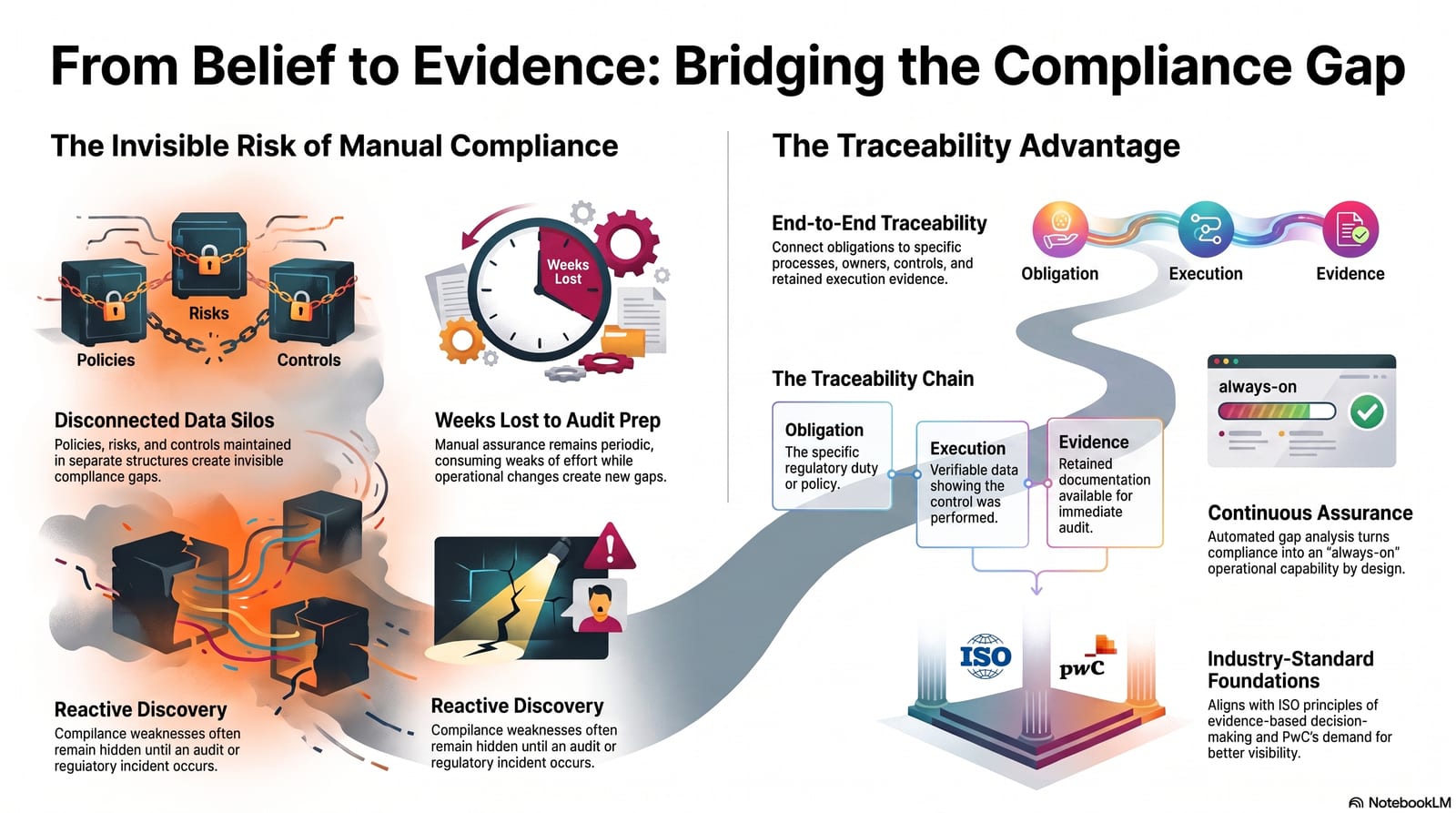
You know you’re compliant, but you cannot prove it. This episode covers why that gap stays invisible during normal operation, what a chaotic, manual scramble for audit evidence actually costs an enterprise, and why a rigorous, unbroken chain of traceability, from obligation through process, owner, system, control and execution to retained evidence, turns assurance from a periodic fire drill into a continuous, evidence-by-design capability.
Drawing on PwC’s 2025 Global Compliance Survey of 1,802 executives and ISO’s quality management principles, the conversation walks through why publishing a policy proves nothing about whether it’s followed, and how connecting iGrafx’s governed risk and control content with IGX360 Insights lets organisations catch a compliance gap the moment it’s created, not three months later in a scheduled audit.
Read the full transcript
Host: Picture this scenario for a second. You're sitting at your desk, just going through your normal morning routine.
Co-host: Right, coffee in hand, checking emails.
Host: Exactly, and suddenly you feel this like... creeping, heavy anxiety settling in your chest. Not because you're doing anything wrong, you're actually incredibly confident that your organisation is doing all the right things. You follow the rules, you respect the regulations, your operational teams work hard.
Co-host: Right, you're a good corporate citizen.
Host: Yeah, but suddenly you realise something terrifying. If someone were to walk into your office right now, say an external auditor or a regulator, and simply ask you to prove it,
Co-host: Right, to actually provide concrete, verifiable evidence that you are compliant across the board at this exact second, you realise you have absolutely no idea where that proof actually is.
Host: Yeah, that's a phenomenal amount of pressure to carry.
Co-host: It really is. You know you're compliant, but you cannot prove it. It's basically the corporate equivalent of knowing you paid a massive tax bill, right?
Host: But the collection agency is on the phone. The deadline is literally today, and you cannot find the receipt anywhere.
Co-host: Oh, that's the worst feeling.
Host: It's terrible. Because the reality of the action doesn't matter at all if you can't produce the evidence of the action.
Co-host: And in a modern regulatory environment, lacking the proof is treated exactly the same as committing the violation.
Host: Wow, yeah, then that exact feeling of flying blind, that is the foundation of our deep dive today. We're pulling from a highly targeted stack of sources to really figure out how
Co-host: A very prevalent issue.
Host: Super prevalent.
Co-host: So today we're synthesising a strategic enterprise framework. It's literally titled P4. We think we are compliant, but cannot prove it.
Host: Great title.
Co-host: It's nail on the head. And we're looking at that alongside some really fresh data from PwC's 2025 Global Compliance Survey and also some foundational ISO quality standards.
Host: Really robust sources today.
Co-host: Yeah. Our mission here is to unpack why so many modern organisations find themselves just trapped in this visibility gap, the hidden costs of operating this way, and most importantly, how to fundamentally rewire your enterprise architecture so you can guarantee proof at a moment's notice.
Host: Which is the holy grail.
Co-host: Exactly.
Host: Okay, let's unpack this. Where does this widespread illusion of compliance actually begin?
Co-host: Well, if you look under the hood of most enterprises, you'll see a pretty fatal structural flaw, honestly, and it's isolation.
Host: Isolation.
Co-host: Yeah, the P4 strategy document maps out this current environment very clearly. Inside a typical company, you have your obligations, your processes, your operational risks, and your controls.
Host: Right. All the standard pieces.
Co-host: Right. They're critical components, but they're maintained in completely separate technological and departmental structures. They are functionally isolated from one another.
Host: So we're talking about like massive multinational corporations where the legal team is tracking obligations in some custom database, right?
Co-host: Yes.
Host: And then the operations team is managing daily processes in a completely different... I don't know, ERP workflow tool like SAP or something.
Co-host: Exactly. And meanwhile, the risk team is sitting in a totally different building tracking controls on this massive disconnected SharePoint spreadsheet.
Host: Oh, the dreaded mega spreadsheet. We all know it well.
Co-host: And this creates a severe structural blind spot. Because these systems just do not communicate, the compliance checks are relegated to periodic manual reviews.
Host: I see. So the day-to-day reality of how the business runs is completely divorced from the system that monitors whether the business is running safely. Okay, it's like claiming to be a master chef, right? But keeping your recipes, your raw ingredients, and your cooking methods locked in three completely different vaults.
Co-host: That's a great way to look at it. Like, you know you can bake the cake and your team is probably baking it perfectly every single day, but you absolutely cannot prove it to the health inspector when they show up unannounced.
Host: Because you can't show them how the ingredients connect to the recipe in real time. Right, you have to ask the inspector to like wait in the lobby while you literally run between the vaults.
Co-host: Yeah, and the chef analogy gets right to the heart of the friction here. Because those elements are locked in different vaults, the compliance gaps remain entirely invisible during normal operation.
Host: They're just totally hidden.
Co-host: Exactly. You literally cannot see where the system is breaking down or where a recipe was altered, you know, on a random Tuesday afternoon. You are just operating on the assumption of compliance.
Host: So when do you actually see the gaps? Because eventually that fragmented reality is going to bite you.
Co-host: Well, the gaps only become visible when an external force demands that the organisation prove how a specific obligation operates in practice.
Host: Like an audit?
Co-host: Usually an audit, yeah. Or a sudden regulatory shift, a formal assurance request, or honestly, worst of all, a severe operational incident.
Host: Oh, wow.
Co-host: Yeah. It is only when you are forced to forensically reconstruct the past that the illusion of control finally shatters.
Host: That sounds like a terrible way to run a business. You're essentially waiting for a crisis to find out if your everyday operations are sound.
Co-host: It's very reactive. It's like waiting for a car crash to find out if your seat belts were installed correctly on the assembly line rather than, you know, testing them during manufacturing.
Host: Yes.
Co-host: And that reactive posture triggers a massive domino effect of negative consequences. When these invisible gaps are finally exposed by an impending audit, the scramble to find the proof is just chaotic.
Host: I can imagine.
Co-host: Audit preparation in these siloed environments ends up consuming weeks, sometimes months, of highly paid employee time.
Host: Just to prepare the evidence that should already exist as a byproduct of doing the work.
Co-host: Yes, exactly. Because someone has to manually act as the bridge between those disparate systems. They have to pull the legal obligation, find the operational manager, track down the IT logs, and somehow stitch them all together into a coherent narrative for the auditor.
Host: That sounds exhausting.
Co-host: And because the gaps were completely invisible until that very moment, the inevitable findings from the audit generate massive remediation costs.
Host: Because everything's an emergency now.
Co-host: Right. You are forced to pay emergency vendor rates or you have to pull your best engineers off core product work just to fix compliance issues you didn't even know were broken.
Host: Man. Beyond the financial hit, there has to be a pretty severe reputational cost internally too.
Co-host: Oh, the erosion of trust is perhaps the most damaging consequence of all. When leadership or a board of directors or a regulator sees an organisation scrambling for a month just to prove they're doing what they claim to do, confidence just vanishes.
Host: Yeah, I bet.
Co-host: It signals a real lack of operational maturity.
Host: I hear that. I really do. But let me push back on this premise just a bit, because manual reviews are legally mandated in many sectors. You can't just bypass a quarterly SOX control review or a financial audit. Companies dedicate entire departments to sitting down every quarter, opening up the spreadsheets and doing a manual review of all their controls. Are you saying we replace those entirely, or that they're somehow useless?
Co-host: No, we aren't bypassing them at all, but we have to acknowledge they are structurally too slow for operational reality.
Host: Too slow.
Co-host: Yeah, the framework highlights this fundamental speed mismatch that makes those manual reviews completely inadequate on their own. At enterprise scale, assurance, meaning those mandated periodic checks, remains a slow, retrospective process. But operational change is incredibly fast and continuous.
Host: Because the business is moving faster than people checking the business.
Co-host: Yes, operational change creates new gaps way faster than review cycles can ever hope to find them. Think about the reality of a modern enterprise. How often does your company push an update to its software?
Host: Probably daily.
Co-host: Right. Or how often do you change a regional supplier or reorganise a department or alter a customer onboarding workflow?
Host: It's constant.
Co-host: Every single one of those micro changes can subtly break a compliance control. If your business changes daily, but your manual compliance check is only quarterly, you have months of invisible accumulating gaps.
Host: Wow. So the manual review is basically an archaeological dig.
Co-host: Exactly. By the time the risk team finishes checking the first quarter, the operations team is already working in the third quarter with a whole new set of broken controls, new suppliers, and new software patches.
Host: Which is terrifying. And this raises an important question, actually.
Co-host: The strategy documents we are reviewing pose a set of diagnostic questions to help you figure out if your organisation is suffering from this exact speed mismatch.
Host: Okay, what are they?
Co-host: One of the most revealing questions is this. How much effort went into your last audit evidence pack?
Host: Oh, that's a good one.
Co-host: Because if the answer is, we had a tiger team of six people working nights and weekends for three weeks, you immediately know you have a silo problem.
Host: You're completely disconnected.
Co-host: Another critical diagnostic they offer is this. Which obligations currently cannot be traced to a process and a control?
Host: Okay, break that down.
Co-host: If you have a regulatory requirement you must follow, but you cannot instantly point to the specific daily process that fulfils it and the control that monitors it, you are highly vulnerable.
Host: Okay, so we've diagnosed the illness here. The manual silo checks are just failing against the sheer speed and complexity of modern business. Leaving organisations blind until an audit forces this chaotic retrospective hunt for evidence. So how do we actually fix this? What is the structural cure?
Co-host: The cure is establishing an unbroken chain of evidence. The underlying weakness here is the absence of traceability. We have to eliminate the silos and create a permanent, visible thread that runs through the entire enterprise architecture.
Host: A golden thread, basically.
Co-host: Yes. The strategy maps out a very rigorous, contiguous line that this traceability must follow. It starts with the obligation, which must trace directly to a process. That process must trace to a specific owner who is tied to a system. That system relies on a control which monitors the execution. And finally, that execution must directly generate retained evidence.
Host: Wait, let me stop you right there. Because getting from a control down to retained evidence in real time implies that every single employee's daily actions are being logged and monitored.
Co-host: I see where you're going with this.
Host: How is that not a bureaucratic nightmare? Like if I'm an operations manager, I do not have time to manually upload a piece of evidence every time I approve a workflow just to satisfy this unbroken chain.
Co-host: And that is the crucial distinction between the old way of doing things and modern continuous assurance. You are right. If this required human beings to manually log their execution, the business would grind to a complete halt.
Host: People would just rebel.
Co-host: Absolutely. The goal of tracing execution to retained evidence relies on designing systems that passively generate this evidence as a byproduct of the work itself.
Host: Passively generate, okay.
Co-host: The employee just does their job in the ERP system and the system's metadata serves as the retained evidence. It requires zero extra effort from the frontline worker.
Host: Oh, okay. That makes a lot more sense, because I have worked at organisations where proof was essentially just policy publication.
Co-host: Oh, yes. The check-the-box approach.
Host: Totally. Like a new data privacy regulation would drop. The compliance team would draft a twenty-page policy, post it on the company SharePoint site, send out a mandatory company-wide e-mail, and consider the job done.
Co-host: Which is so dangerous.
Host: Right, because hitting publish on an intranet policy doesn't actually prove anything, does it?
Co-host: The strategic framework thoroughly dismantles that publication-equals-compliance myth. Hitting publish on an intranet only proves that your legal team knows what the rule is. It provides absolutely zero evidence that anyone in the operations department is actually following it, or that your IT systems are configured to enforce it.
Host: It's the difference between like buying a complex fitness book and actually losing weight. Having the book sitting on your desk doesn't prove to your doctor that you changed your diet.
Co-host: Exactly. The real indicated value of traceability is proving execution. The benefits of this approach, the lower audit preparation effort, earlier detection of gaps, and faster regulatory impact assessments, those only materialise if every single control has a clear owner and verification evidence that proves the action was actually executed in reality, not just intended on paper.
Host: Proving execution rather than just intention. That sounds incredibly rigorous, but shifting an entire enterprise to this model, that is a massive undertaking. Are companies actually feeling enough pain to justify rewiring their architecture this way, or is this just a theoretical exercise?
Co-host: Oh, it is a validated systemic crisis, and the source material brings in heavy external data to back that up. If we look at the PwC Global Compliance Survey for 2025, the data is staggering.
Host: Let's hear it.
Co-host: This survey represents 1,802 executives from massive organisations.
Host: Wow, that is a massive, highly relevant data set. Over 1,800 execs, what are they actually struggling with on the ground?
Co-host: They are reporting a rapidly compounding level of compliance complexity. We're talking about the intersection of shifting global supply chains, multiplying cross-border data privacy regulations, and incoming AI governance laws.
Host: It's just coming from all sides.
Co-host: It really is. These executives are citing a desperate industry-wide demand for better visibility, for proactive issue identification, dynamic reporting. They are openly admitting that their current siloed systems cannot handle the velocity of modern regulatory changes.
Host: So those 1,800 executives are essentially all sitting in their offices feeling that exact same creeping anxiety we talked about at the beginning.
Co-host: Yes. They know they need better visibility before the audit happens, because the sheer volume of obligations is outpacing their ability to manually check them. They are exhausted by the reactive panic. And the strategy also validates this traceability approach by pointing to the International Organization for Standardization, or ISO.
Host: Right, the gold standard for quality.
Co-host: Exactly. The foundational ISO quality management principles explicitly demand process orientation, evidence-based decision making, and continual improvement.
Host: Which makes sense. But you cannot fulfil a mandate for continual improvement if you only measure your compliance posture once a quarter.
Co-host: Continual improvement requires continuous visibility.
Host: Exactly.
Co-host: And you certainly cannot have evidence-based decision making if your retained evidence takes three weeks to manually compile.
Host: Good point.
Co-host: ISO's core principles are fundamentally incompatible with a siloed, manual assurance environment.
Host: Okay, here's where it gets really interesting. If the industry knows this is a crisis, and these massive global standards demand continuous, evidence-based traceability, how do you actually build it? Because doing that manually across, like, five thousand controls and dozens of IT systems is impossible.
Co-host: It's entirely impossible to do manually, which is why the solution relies on specific technology to automate the connections across the silos. The framework points to a very specific product route to achieve this.
Host: Okay, what is it?
Co-host: It involves utilising a platform called iGrafx to establish the governed risk and control content.
Host: Unpack how that works mechanically. What is iGrafx actually doing in this scenario?
Co-host: Think of it as creating a dynamic digital twin of your organisation. iGrafx maps out the rules of the road. It ingests your obligations, your operational risks, your internal policies, and your governance frameworks, and it maps the relationships between all of them.
Host: Okay, so it builds the theoretical structure.
Co-host: Right, but that is only half the battle. You then combine that structural map with IGX360 Insights, which provides the compliance and gap lenses.
Host: Okay, so how do they interact to actually automate the gap analysis? Like, give me an example. If an operations manager in Berlin changes a data routing rule in their local SAP system, how does this technology catch the compliance gap before the quarterly review?
Co-host: Because the platform integrates with your actual operational systems, when that manager in Berlin changes the routing rule, IGX360 reads that change in the metadata.
Host: Passively.
Co-host: Passively, exactly. It maps that altered process against the digital twin in iGrafx. It instantly recognises that a process tied to a specific GDPR obligation has been modified, and the associated control is now either orphaned or degraded.
Host: Wow. So it's like instead of relying on a security guard who only walks the perimeter of your massive corporate campus once a month with a flashlight, right, which is your annual periodic review.
Co-host: This technology acts like a permanent live-feed security camera system. It watches the relationship between every door, window, and employee twenty-four seven.
Host: That's a perfect analogy.
Co-host: The second the door is left propped open, the system flags it.
Host: The live feed camera is exactly the right way to visualise it.
Co-host: What this technology does mechanically is turn assurance into a continuous capability. It utilises connected controls and automated gap analysis so that you don't have to wait for the security guard's monthly report.
Host: Continuous capability. That is a massive paradigm shift for how risk teams operate.
Co-host: It alters the fundamental relationship between operations and compliance. The strategic framework explains that in practical terms, this allows change and assurance to be managed together as connected operational work.
Host: Connected operational work. Let's really make sure we understand the friction this removes, because it sounds like the complete antithesis of the silo effect.
Co-host: It is. In the old siloed world, change and assurance were disconnected events separated by time. The operations team would implement a massive change, perhaps migrating a critical database to a new cloud provider, and they wouldn't formally notify the compliance team.
Host: Because they're in a different building.
Co-host: Right. So the compliance team would only discover three months later, during a scheduled audit, that a crucial data residency control was broken during the migration.
Host: The gap lived in the dark for ninety days.
Co-host: But with this continuous capability, the moment the IT team reconfigures the cloud database, the automated gap analysis immediately flags the impact on the data residency control. The assurance happens concurrently with the operational change.
Host: They're inextricably linked.
Co-host: The gap never has time to become invisible. The system creates accountable remediation instantly, and more importantly, it ensures that evidence is available by design.
Host: Available by design, meaning you no longer have to pull a six-person tiger team to work weekends for a month to prepare for an audit.
Co-host: Never again. The retained evidence is automatically generated and structurally linked to the obligation the moment the work is executed.
Host: The proof isn't something you have to hunt for.
Co-host: It's just naturally there. You achieve defensible traceability from the initial legal duty all the way down to execution, without the friction, the panic, or those massive remediation costs.
Host: This has been a really revealing look at the mechanics of modern enterprise risk. For you listening, we've covered a lot of ground today. We started in a reality that is likely very familiar, that siloed environment where your policies, processes, and controls are locked in completely different organisational vaults, leaving you just waiting for an audit or an incident to expose your vulnerabilities.
Co-host: Yeah, that anxious reality. We broke down the painful domino effect of that reality too. The weeks of wasted time manually stitching evidence together, the massive remediation costs, and the severe damage to leadership confidence.
Host: And we also diagnosed the root cause, which is the fundamental speed mismatch between the rapid velocity of modern operational change and the inherently slow, retrospective nature of traditional manual assurance.
Co-host: But then we explored the cure, right? Building that golden thread of traceability.
Host: We walked through the rigorous, contiguous chain from obligation to process, down to owner, system, control, execution, and finally retained evidence.
Co-host: That's the vital path.
Host: Yeah, we saw how the data from 1,800 global executives in the PwC survey, alongside those core ISO principles, are really demanding this exact kind of evidence-based, process-oriented approach.
Co-host: And finally, we unpacked the mechanics of how utilising a connected product route, specifically iGrafx and IGX360 Insights, can automate gap analysis, turning panic-inducing audit prep into a smooth, continuous capability where evidence is just available by design.
Host: It transitions an enterprise from operating on the hopeful assumption of compliance to mathematically verifying it in real time.
Co-host: If examining this strategy has you looking at your own internal architecture and feeling that creeping anxiety return, the framework provides a highly actionable next step.
Host: You don't have to boil the ocean and replace every legacy system tomorrow.
Co-host: No, start small.
Host: Right.
Co-host: The call to action is incredibly focused. Book a call to map just one single obligation.
Host: Take one critical policy and trace it through process, control, owner, and evidence using this methodology.
Co-host: Just seeing that one single thread illuminated and automated can demonstrate exactly what continuous traceability feels like in practice.
Host: And as you think about mapping that first connection, I want to leave you with something to consider. The strategy notes that compliance gaps remain invisible until an audit or incident forces the issue. We spent a lot of time today discussing the panic of a scheduled official audit. But what if the ultimate test of your compliance wasn't an audit with weeks of lead time?
Co-host: What if it was an entirely unexpected, overnight operational crisis?
Host: Oh, wow.
Co-host: If a sudden, massive external shock hit your organisation tomorrow morning, a severe cyber breach, a geopolitical supply chain collapse, or an immediate regulatory freeze, would your retained evidence hold up under instant, unforgiving scrutiny. Or would you discover in the middle of a crisis that your entire compliance structure was just an illusion?
Want to see what this looks like on your own BPM content? One conversation is enough to start.