Bring your documented process and daily work together
In your words: “Our documented process is not how the work actually gets done”
- Design-reality gap
- Process validation
- Execution alignment
A process is modelled for governance but daily work happens elsewhere. This becomes most visible when work crosses teams, approvals and systems while execution is coordinated outside the approved process model.
When the process model and daily execution are connected, the model stays useful and governance reflects real work. Approved workarounds become part of the design.
Automation, reporting and compliance work from one version of the truth. Improvement becomes a loop between design, execution and analysis.
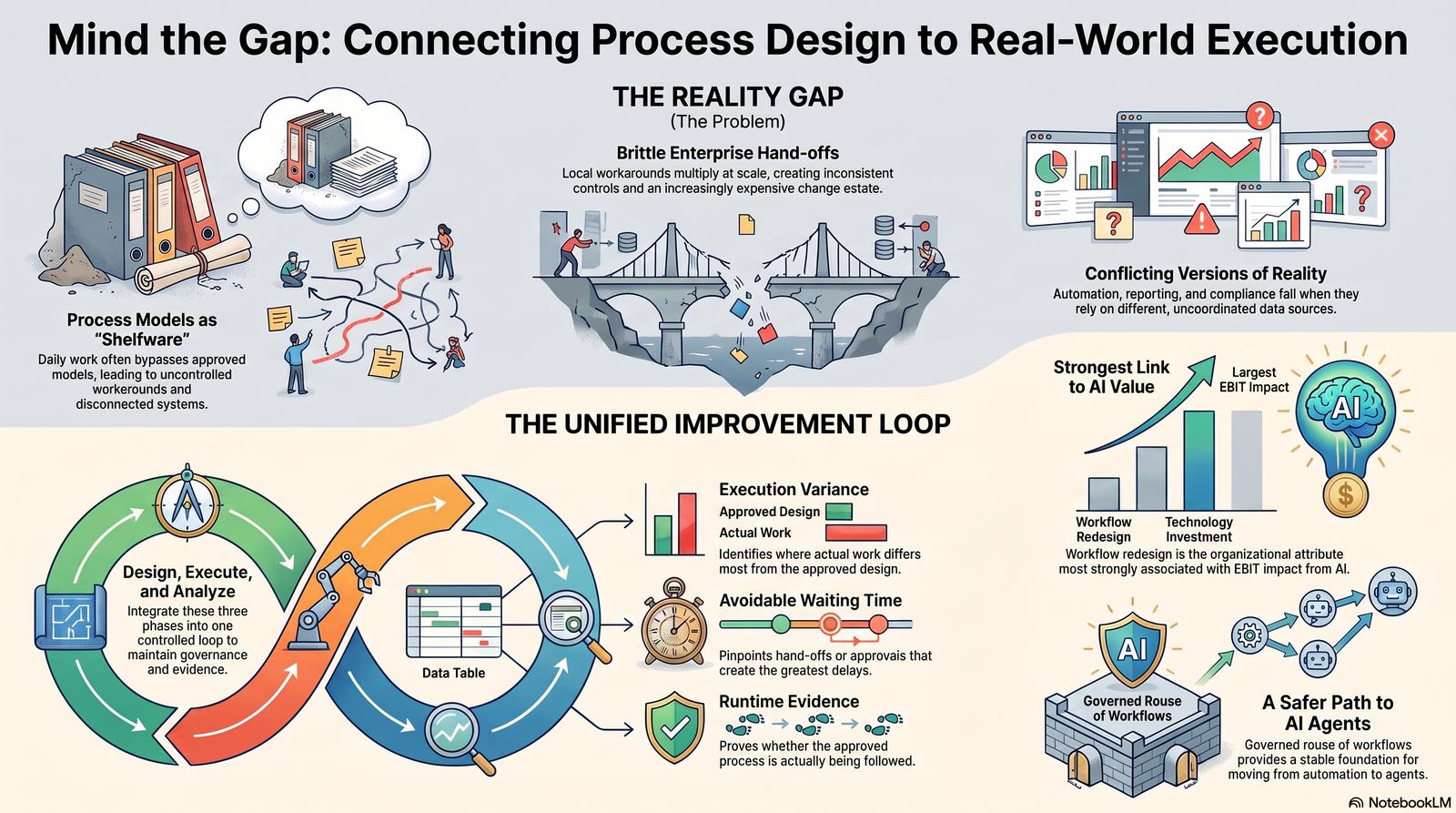
Design, execution and analysis become one controlled improvement loop. In practical terms, the organisation can automate priority work now while retaining governance, evidence and a deliberate path toward greater autonomy.
- One governed thread from approved design to execution and improvement; less shelfware and automation rework
- Visible work status and accountability
- Reduced manual coordination and rework
- Governed reuse of workflows and controls
- A safer path from automation to agents
- Which approved process has the greatest execution variance?
- How is a workflow change reflected in the governed model?
- Can actual outcomes be traced back to the approved design?
- Which hand-off or approval creates the greatest avoidable waiting time?
- What runtime evidence would demonstrate that the approved process is actually being followed?
McKinsey found workflow redesign was the tested organisational attribute with the strongest association to EBIT impact from generative AI.
McKinsey: The State of AI: Rewiring to Capture Value
ISO explains that managed processes and their interactions support consistent results, performance evaluation and continual improvement through the process approach and PDCA cycle.
ISO: The process approach in ISO 9001