Prove what to improve first
In your words: “We have dozens of improvement opportunities but no evidence for what to fix first”
- Improvement prioritisation
- Process baselining
- Evidence-based improvement
Improvement ideas are driven by anecdotes, urgency or seniority rather than comparable evidence. This becomes most visible when decisions must cross functions, systems or organisational boundaries and no single owner can supply a trusted answer.
Comparable evidence turns a long list of ideas into a ranked plan. Teams can set a baseline, agree what matters and show the value of each change.
Scarce investment goes where the evidence points, benefits are demonstrated and confidence in improvement grows.
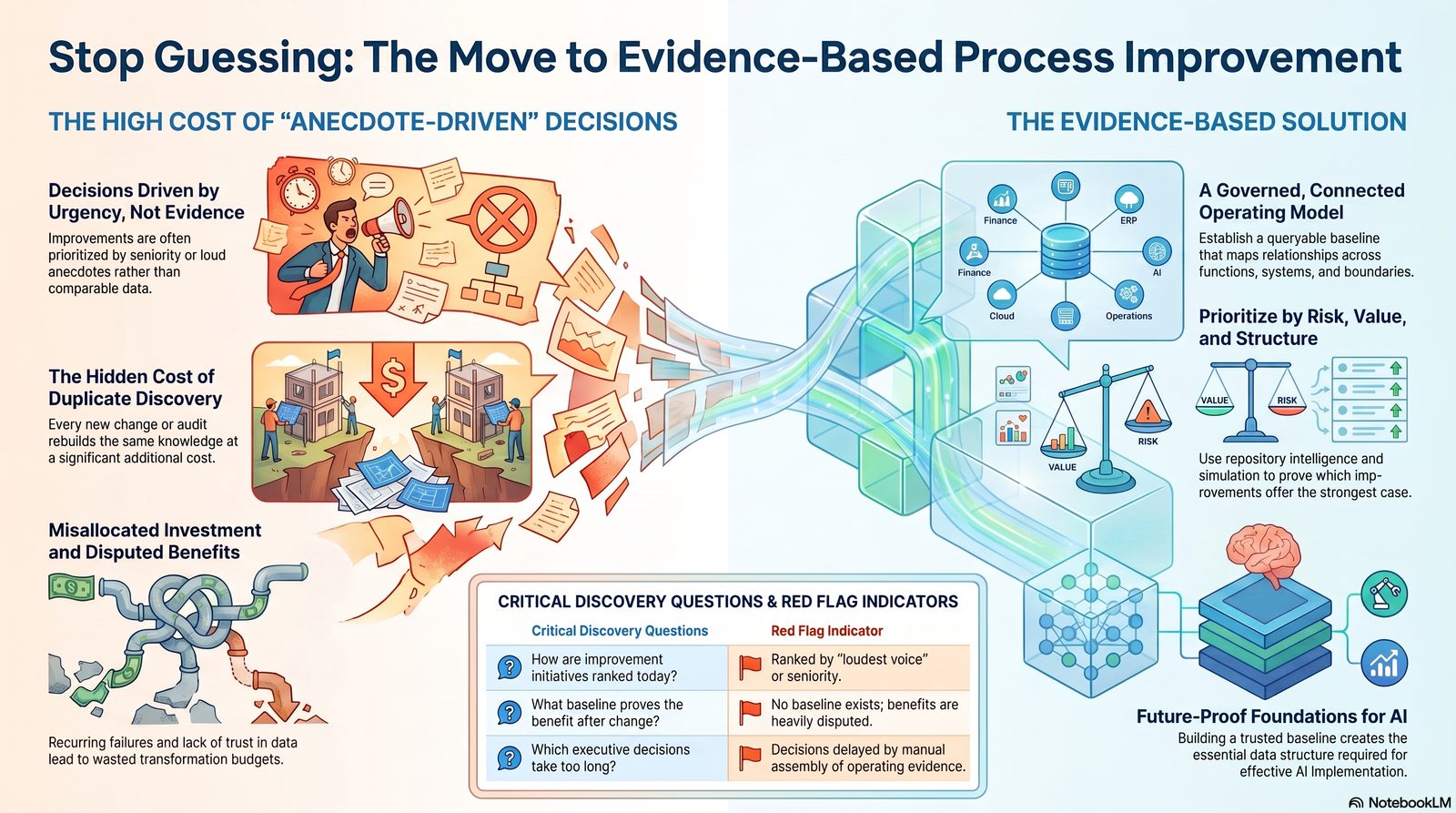
Repository intelligence and simulation prioritise change by risk, value and structural evidence. In practical terms, leaders and delivery teams can work from the same baseline, interrogate relationships quickly and govern updates as the organisation changes.
- Better prioritisation of improvement spend; clearer baselines and more credible demonstration of value
- A trusted operating baseline
- Faster ownership and impact analysis
- Less duplicate discovery and reconciliation
- Stronger foundations for improvement, assurance and AI
- How are improvement initiatives ranked today?
- What baseline proves the benefit after change?
- Which high-risk gap currently has no quantified case?
- Which executive decision currently takes too long because operating-model evidence must be assembled manually?
- What governance event causes the process baseline to be reviewed and updated?
APQC positions process governance, performance measures and benchmarking as essential to sustainable process improvement.
APQC: Process Management
ISO identifies process orientation, customer focus, evidence-based decision-making and continual improvement as foundations of effective quality management.
ISO: Quality management principles