Getting Your Process Ready Before AI Automates It
Most AI programmes get added to a process that exists on paper, while real work runs through undocumented workarounds. This episode covers how to bring approved design and the running process together, so AI automates what you intend it to.
Episodes feature AI-generated hosts discussing human-written IGX360 research.
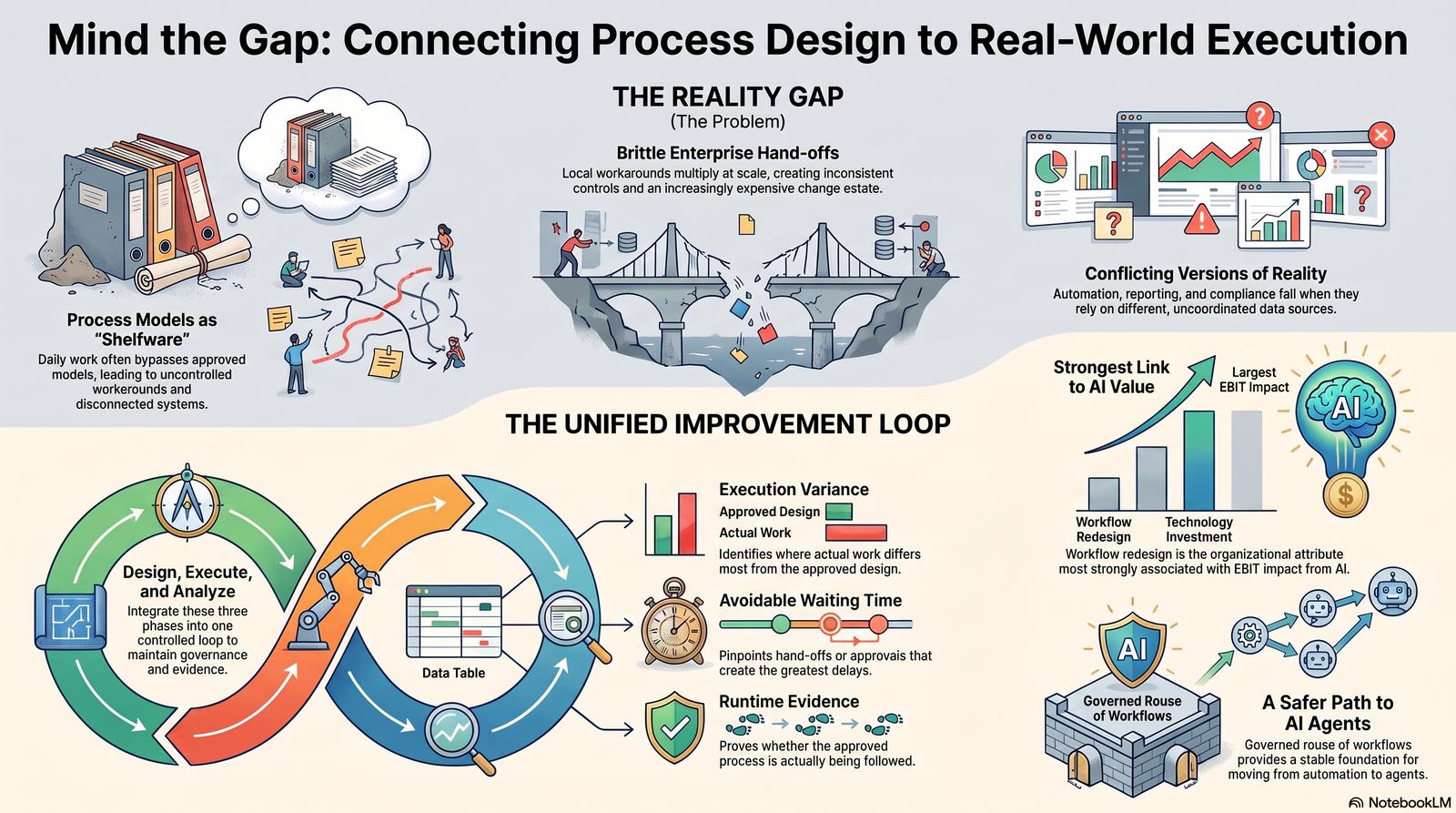
The most sophisticated AI on the market pays off fastest when the process it sits on is understood. Behind many processes is one person, and an undocumented spreadsheet that holds the working knowledge. This episode covers how to close the gap between the approved design and how the work is done, what that gap costs once local workarounds multiply into brittle handoffs, and why doing it first is what makes generative AI pay off.
Drawing on McKinsey’s finding that workflow redesign carries the strongest association with EBIT impact from generative AI, and ISO 9001’s plan-do-check-act cycle, the conversation makes the case that AI plugged into a governed process scales the good. A governed thread from process design through execution to analysis, using iGrafx, iGrafx Workflow and IGX360 Insights, turns automation into a safe route to agents.
Read the full transcript
Host: Right now, your company is probably spending millions of dollars on generative AI initiatives. You've got task forces, steering committees, the whole nine yards.
Co-host: Yeah, everybody has one.
Host: But what if I told you that because of one guy named Dave in accounting, all that cutting-edge AI is just going to make your company fail faster?
Co-host: It sounds totally absurd, right?
Host: It is actually one of the most critical threats facing enterprise organisations today. You can buy the most sophisticated AI on the market, but if it's plugged into a system that's secretly held together by Dave's undocumented spreadsheets...
Co-host: You're just automating chaos.
Host: Exactly. You're just automating chaos at light speed.
Co-host: Welcome to today's deep dive.
Host: We are tackling a really fascinating piece of source material today. It's a highly insightful business architecture framework document, and it's titled P7: The Approved Design Is Not How the Process Runs.
Co-host: Such a great title, honestly.
Host: Right. It uses this SPIN structure: situation, problem, implication, need, payoff.
Co-host: And our mission for this deep dive is to explore the massive, and I mean entirely invisible, gap between how an organisation thinks it operates and how the work actually gets done.
Host: Yeah, like on a random Tuesday afternoon.
Co-host: Exactly. And crucially, we're going to explore why closing this gap is the unglamorous secret key to actually successfully implementing AI.
Host: It really is.
Co-host: So to you listening right now, I want you to think about your own workplace. How often do the official rules or the official process maps actually match your daily reality?
Host: Probably never. Right.
Co-host: When you need to get something put through quickly, do you follow the official fifty-step flow chart, or do you just DM Dave on Slack because you know he'll bypass the system?
Host: We all know a Dave. We do. Okay.
Co-host: Let's unpack this, because the document starts by laying out this fundamental disconnect at the heart of modern work.
Host: It says that processes are modelled for governance, but the daily work happens elsewhere.
Co-host: That is the absolute crux of the issue. I mean, organisations spend months, sometimes years, and millions of dollars mapping out exactly how a process should work.
Host: This is the governance side. And it looks beautiful on a whiteboard.
Co-host: Oh, the perfect little geometric shape scenario.
Host: Exactly. But the execution, the actual doing of the work, is coordinated completely outside of that approved process model.
Co-host: And the document notes that this disconnect is most visible when work crosses teams, right? Like when it requires cross-departmental approvals or multiple software systems.
Host: Yes, that's when the official model just completely falls apart. It becomes what the document calls shelfware.
Co-host: Shelfware. It's such a perfect word for it.
Host: It really is. The model literally just sits on a shelf gathering dust, completely divorced from reality.
Co-host: And while it sits there, the execution develops all these uncontrolled workarounds, because people just have to get the job done.
Host: Right, they find a way, but it has absolutely nothing to do with the approved design.
Co-host: It makes me think of a house. Like the approved design is this pristine, untouched, formal dining room.
Host: I like that.
Co-host: The table is perfectly set, the crystal is out, perfectly folded white napkins. It's what you show the guests.
Host: Right. It's what the architects designed for eating.
Co-host: Exactly.
Host: But the actual process is the messy kitchen in the back, where everyone is eating over the sink, bumping into each other and congregating around the island.
Co-host: Literally no one is in the dining room.
Host: That is a perfect analogy.
Co-host: But wait, I have to ask, is this gap just happening because employees are lazy? Are we all just rebellious rule-breakers ignoring the dining room? Or is the approved design fundamentally broken from the start?
Host: Well, what's fascinating here is that the document explicitly points to a structural failure, not a moral one.
Co-host: It's not laziness. The underlying weakness is the absence of what they call a controlled connection.
Host: A controlled connection. Right.
Co-host: There is a missing structural link between the process design, the executable work, the decision rights, and runtime evidence.
Host: Wait, runtime evidence. Break that down for me. What does that actually mean for the employee standing in the messy kitchen?
Co-host: It means the people doing the work don't have clear decision rights linked to the actual task. Without runtime evidence, meaning without data automatically capturing that the approved path was followed, people are forced to create workarounds just to survive the day.
Host: Just to keep things moving.
Co-host: Exactly. If the official process requires three days of waiting for some automated email that never triggers, they're going to bypass it.
Host: Right. But because there's no runtime evidence, management has no idea the workaround even exists.
Co-host: There's no footprint.
Host: Wow.
Co-host: So management is looking at the spotless dining room, seeing the final product delivered, and thinking the process worked exactly as designed.
Host: Yes. They are completely blind to the fact that everyone is crammed in the kitchen using duct tape and custom macros to actually get it done.
Co-host: Okay, so once we understand why people abandon the approved model, we have to look at the cascading damage this causes at scale, right? Moving into the implications.
Host: Oh, the damage at scale is massive, because automation, reporting and compliance all end up relying on totally different versions of reality.
Co-host: At an enterprise scale, these local workarounds just multiply. So you get brittle handoffs, inconsistent controls.
Host: Well, here's where it gets really interesting. It's like building a skyscraper on a foundation of sand, right? If the compliance and reporting teams are looking at a pristine blueprint that doesn't match the actual messy plumbing,
Co-host: any changes they make will literally break the building.
Host: Yes.
Co-host: The document says this creates an increasingly expensive change estate.
Host: I want to push you on that phrase. What does an expensive change estate actually mean for an organisation that's trying to adapt?
Co-host: Yeah, that's a crucial concept. Your change estate is essentially everything you need to manage, update or fix when you want to make an organisational shift.
Host: Okay.
Co-host: Now imagine a fragmented reality where every local team has automated their own uncontrolled workarounds instead of the company uniting.
Host: Right.
Co-host: When local teams do that, they're essentially building these brittle bridges that can collapse at any moment.
Host: Wow.
Co-host: So say leadership wants to update a compliance protocol. On the blueprint, it looks like one simple change.
Host: But in reality, you try to change one system and fifty invisible workarounds suddenly shatter.
Co-host: Because they depended on the old undocumented structure.
Host: Exactly.
Co-host: The cost to untangle and fix all that becomes astronomically expensive.
Host: It makes any organisational change incredibly costly and dangerous.
Co-host: That is terrifying.
Host: But thankfully, the conversation naturally shifts to the cure, right? How to fix this change estate by looking at the need-payoff and the benefits.
Co-host: Yes, there is a way out of the chaos. And the goal, according to the document, is to make design, execution and analysis into one controlled improvement loop.
Host: One controlled loop, not three separate silos.
Co-host: Right.
Host: Practically, organisations can automate priority work now while still retaining governance, evidence, and a path to autonomy.
Co-host: Which is huge.
Host: The benefits listed are pretty wild. One governed thread from approved design to execution, less shelfware, visible work status, and reduced manual coordination. And governed reuse of workflows and controls.
Co-host: That's a big one.
Host: But let me ask a sceptical question on behalf of the listener here. Doesn't forcing everyone back onto one governed thread just mean adding more bureaucratic red tape? Isn't that just going to slow everything down?
Co-host: It's a fair question, but if we connect this to the bigger picture, it's actually the exact opposite of red tape.
Host: Really? How so?
Co-host: By having visible work status and the governed reuse of workflows, you drastically reduce manual coordination.
Host: Oh, because you aren't sending five emails to find out where a project is.
Co-host: Exactly. And it reduces avoidable rework. It's about creating a deliberate path to autonomy, not restricting it. When the system actually supports the work, you don't need the shadow workarounds.
Host: It's like paving a dirt path that people were already walking on anyway.
Co-host: Yes, exactly that.
Host: Okay, so this controlled improvement loop isn't just about saving time today. It is the fundamental prerequisite for the AI revolution, which brings us to the external validation and the product route in the document.
Co-host: This is where it gets incredibly urgent for leaders.
Host: Right, because the document notes a safer path from basic automation to AI agents. And they cite a McKinsey study that found workflow redesign is the organisational attribute with the strongest association to EBIT impact, that's earnings before interest and tax, from generative AI.
Co-host: That is a massive finding. So what does this all mean for the listener? If you want generative AI to actually impact your bottom line, your EBIT, you can't just plug it into a messy, undocumented workaround.
Host: You absolutely cannot.
Co-host: You can't just unleash AI onto Dave's private spreadsheet and expect a miracle.
Host: Right, because the AI will just learn the broken process.
Co-host: And this is where the document grounds its argument in ISO validation.
Host: ISO 9001, right?
Co-host: Yes. It explains that managed processes support continuous improvement through the PDCA cycle.
Host: PDCA: plan, do, check, act.
Co-host: Exactly. It's the engine of continuous improvement. You plan the model, you do the execution, you check the results, and you act to improve.
Host: Okay, but how does that relate to the AI problem?
Co-host: If you plan the model on the shelf, and you do the actual execution in the kitchen, and they're entirely disconnected,
Host: Oh, I see. You can never effectively check or act.
Co-host: Exactly. The cycle is broken.
Host: A governed thread is what fixes that, providing a much safer path from simple automation to autonomous AI agents.
Co-host: Agents need to be able to run that cycle.
Host: And the document points to a specific product route to fix this, right?
Co-host: iGrafx to iGrafx Workflow to IGX360 Insights.
Host: Yes. It's a specific architectural bridge.
Co-host: You use iGrafx to design the governed model, then move it into iGrafx Workflow to actually execute the work based on that exact design.
Host: So the map becomes the territory.
Co-host: Yes, and then that feeds directly into IGX360 Insights for the analysis.
Host: It connects the plan, do, and check.
Co-host: Okay, to make this highly actionable for the listener, we need to pivot to how they can identify these gaps in their own day-to-day work.
Host: Yeah, the document has these great discovery questions.
Co-host: Let's go through them.
Host: Which approved process has the greatest execution variance?
Co-host: Second, how is a workflow change reflected in the governed model?
Host: Meaning, does the blueprint actually get updated when you change how you work?
Co-host: Right.
Host: Third, can actual outcomes be traced back to the approved design?
Co-host: Fourth, which handoff or approval creates the greatest avoidable waiting time?
Host: That's a painful one for a lot of people.
Co-host: Oh yeah. And finally, what runtime evidence would demonstrate the approved process is being followed?
Host: This raises an important question, really. If you cannot trace your actual outcomes back to an approved design,
Co-host: your organisation is basically flying blind.
Host: Because you have no runtime evidence.
Co-host: Exactly.
Host: So listener, I want you to think about your own job right now. Which handoff or approval are you dealing with today that creates the most avoidable waiting time?
Co-host: Like, where is your messy kitchen?
Host: Yeah, find that bottleneck.
Co-host: Because the call to action here is brilliant. It says to book a call to trace just one approved process from model to actual execution to identify the gap.
Host: Just one.
Co-host: You don't have to fix the whole company overnight.
Host: Just trace one single process to reveal the gap.
Co-host: Just shining a light on it.
Host: So let's summarise this journey. We started with a dusty process model sitting on a shelf.
Co-host: Total shelfware.
Host: We uncovered the expensive chaos of invisible workarounds, the brittle change estate.
Co-host: And we discovered that unifying design and execution is literally the only true way to prepare an organisation for generative AI.
Host: Without a doubt.
Co-host: And why should you care?
Host: Because understanding this gap makes you uniquely equipped to spot operational bottlenecks in your own role.
Co-host: Yeah, you can actually fix the plumbing.
Host: Exactly.
Co-host: It allows you to advocate for real governed automation rather than just adding another shadow workaround to the messy change estate.
Host: Which is incredibly empowering.
Co-host: It is.
Host: I'd like to leave the listener with a final thought built on all this.
Co-host: Please do.
Host: We know AI needs a governed thread, but if generative AI eventually becomes capable of observing our daily uncontrolled workarounds in real time...
Co-host: Like watching us in the messy kitchen.
Host: Exactly. Will that AI automatically rewrite the approved design to match our reality, or will it simply learn our bad habits at light speed?
Co-host: Oh wow, automating our dysfunction permanently.
Host: Exactly.
Co-host: That is a wild thought to leave on.
Host: Thank you for joining the deep dive today. Keep questioning the systems around you, and we'll catch you next time.
Want to see what this looks like on your own process architecture? One conversation is enough to start.