Prioritising Improvement by Evidence
Improvement backlogs work best when they are ranked on evidence. This episode covers how a queryable digital twin and simulation replace opinion, so benefits are demonstrated and each audit, incident or programme builds on shared knowledge.
Episodes feature AI-generated hosts discussing human-written IGX360 research.
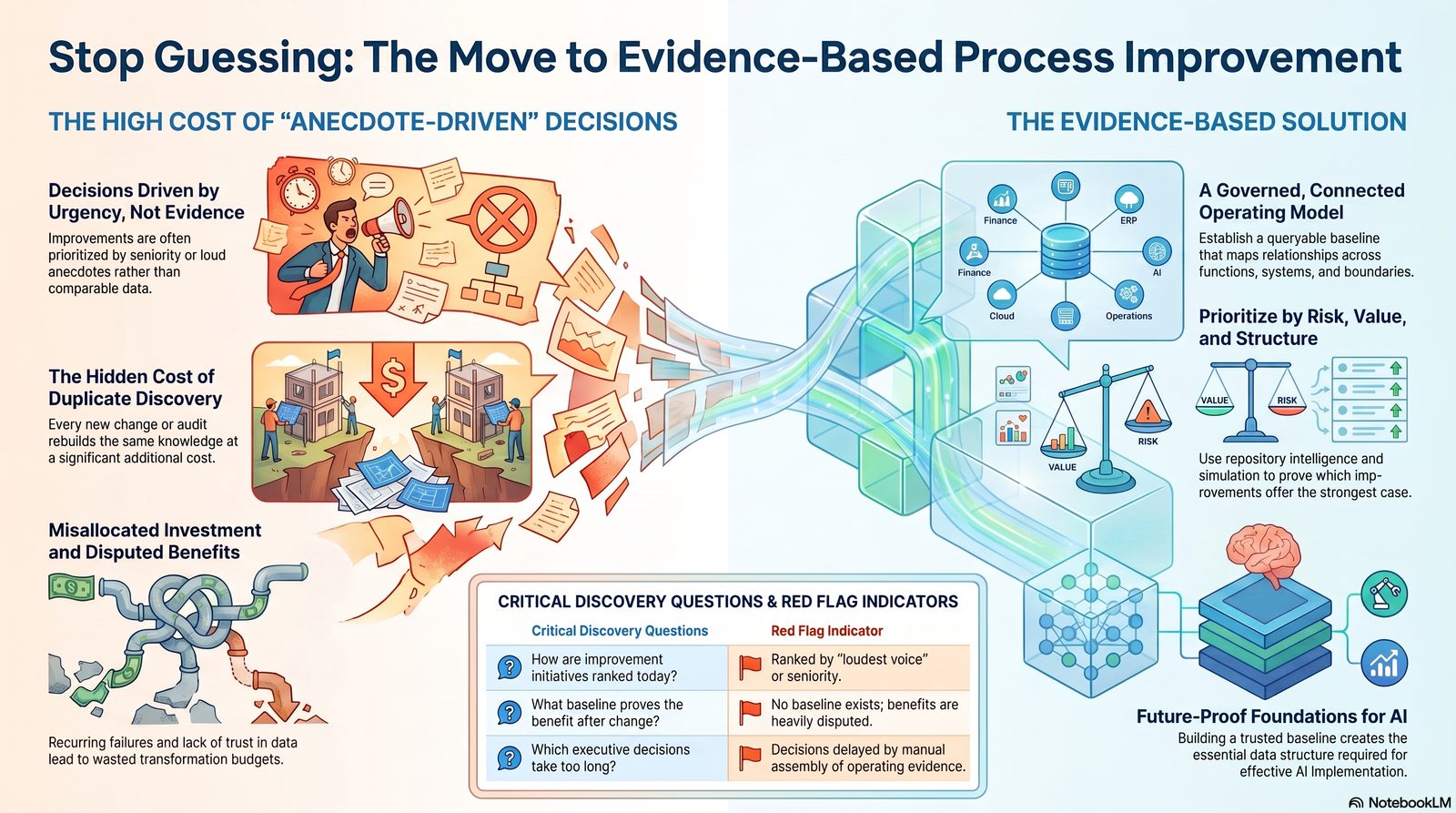
Improvement backlogs get the best results when they are funded on evidence. Without a governed, connected and queryable model of the business to point to, priorities can end up set by the highest paid person’s opinion or the most convincing anecdote in the room. This episode covers how to move to evidence-led prioritisation, especially for problems that cross functional boundaries, and how to stop rebuilding the same discovery work for every audit, incident and transformation programme.
Drawing on APQC’s position that governance, performance measures and benchmarking are essential to sustainable improvement, and ISO’s framing of evidence-based decision-making as a foundation of quality management, the conversation uses a flight simulator analogy: rather than finding out what breaks in live operations, leaders query a model of the operating model and test a change against it before a single resource is committed. IGX360 Insights paired with iGrafx supports that, so the case for improvement is proven, not pitched.
Read the full transcript
Host: Have you ever been part of a project where the decision on what to fix first was based entirely on whoever was just panicking the loudest?
Co-host: Oh, I mean, I think we all have, right? It's painfully common.
Host: Right. Like you're sitting in a meeting room, or maybe you're staring at this giant grid of faces on a video call, and there's a massive issue facing the company.
Co-host: Everyone is just so stressed out.
Host: Exactly. But instead of a calm, calculated analysis of where to deploy resources, the entire strategy just becomes, let's quiet down the person who's yelling.
Co-host: Yeah, or let's just do whatever the person with the biggest title wants to do.
Host: Right. The HiPPO method. Highest paid person's opinion.
Co-host: Well, welcome to today's deep dive. We have tailored this specific conversation just for you, the listener, because we are pulling apart a really fascinating strategy document titled P8: We Cannot Prove What To Improve First.
Host: It's a great title, very direct. It really is.
Co-host: And our mission today is to unpack this framework and explore exactly why organisations fundamentally fail at prioritising their improvements, and how adopting a structural, evidence-based baseline can completely change the game.
Host: Yeah, and this is a reality that really cuts right to the bone for anyone in management, because no executive wants to admit that they're just flying by the seat of their pants.
Co-host: Oh, definitely not. They want to project total certainty.
Host: Exactly. They want to look like they have all the answers.
Co-host: But when you look at how modern organisations actually operate, navigating these complexities across global markets, this source material exposes a massive hidden vulnerability.
Host: Which is what exactly? Like what's the core of it?
Co-host: It's this absolute reliance on anecdote and urgency over actual evidence. And it is just draining resources and completely burning out teams.
Host: Wow. Okay, so let's unpack this. Let's look at the reality on the ground.
Co-host: The document points out that improvement ideas are currently driven by anecdotes, urgency or seniority rather than comparable evidence, and that is so dangerous.
Host: Right. It's literally the loudest voice dictating a multi-million dollar strategy.
Co-host: But you know what's fascinating here is the psychology of why that happens. Because it's rarely because leaders are malicious or even incompetent.
Host: No, usually they're trying to do the right thing. Right, they are.
Co-host: But it happens because in the absence of hard, comparable evidence, human beings just default to heuristics. We default to stories, like whoever has the most compelling narrative wins.
Host: Exactly. Like if a senior vice president comes into a boardroom and says, I just spoke to our biggest client and they are furious about this one specific software glitch, that anecdote carries massive emotional weight.
Co-host: Yeah, I'd be sweating if I was in that room. We all would.
Host: It creates an immediate, visceral sense of urgency. Which means the entire engineering team probably just drops what they're doing to fix this one glitch.
Co-host: Yep, they pivot the whole roadmap. Even if the actual data, if they actually had access to it, would show that a completely different underlying issue is quietly causing ninety percent of their customer churn.
Host: Exactly. And the source document highlights where this guessing game becomes the most destructive, and that's when decisions have to cross functional, system or organisational boundaries.
Co-host: Oh, boundaries. Yeah, that's where things always get messy.
Host: Always. Think about the daily reality of a complex business.
Co-host: Right.
Host: If a problem is entirely contained within, say, the marketing department, well, the head of marketing can probably figure it out.
Co-host: Sure, they own the whole sandbox. Right.
Host: But what happens when a problem starts in a marketing campaign, then it moves through the sales software, and then it ends up causing a physical fulfilment error in the warehouse?
Co-host: Oh man, that is when the pointing fingers start.
Host: Absolutely. Like the warehouse manager blames the sales system, the sales director blames the marketing leads. It's just chaos.
Co-host: And why does that happen?
Host: Because across those boundaries, no single owner can supply a trusted answer.
Co-host: Everyone exists in a silo. They only see their tiny piece of the puzzle.
Host: Exactly. So if every department is just optimising their own silo, what happens when a process crosses those boundaries?
Co-host: That's where this lack of a unified baseline just becomes a complete structural failure. Teams end up optimising visible symptoms entirely because they can't establish a baseline.
Host: Okay, let's unpack this, because the document uses a very specific phrase for this underlying weakness. It says organisations suffer from the absence of, and get ready for this, a governed, connected and queryable representation of the operating model.
Co-host: Yeah, that is a very dense, highly corporate sentence. It really is a mouthful.
Host: So let's think about it this way, like an analogy. Fixing an organisation without a queryable representation of your operating model, it's basically like trying to fix a sinking ship by just frantically bailing out the water.
Co-host: Right. Because you're optimising a visible symptom, the water pooling on the deck, but you are not actually looking at the ship's blueprints to find and patch the hole in the hull.
Host: The blueprint is your baseline.
Co-host: That's a great way to look at it. Yeah.
Host: And, you know, taking that ship analogy a step further really shows how these departmental boundaries basically get weaponised.
Co-host: Oh, really? How so?
Host: Well, imagine the engineering team on that ship decides to fix the symptom they see by, say, rerouting the water into a different compartment. They feel great, right? Their deck is dry.
Co-host: But because they don't have a connected, governed view of the entire ship, that blueprint, they don't realise they just pumped all that water straight into the electrical room.
Host: Oh, wow. So they solved their silo problem but caused a catastrophic failure somewhere else.
Co-host: Precisely. And the key word in that dense corporate sentence you read is queryable.
Host: They can't ask the ship, if I pump water here, where does it go?
Co-host: Right, they just do it and cross their fingers. Yeah.
Host: So this is where we have to translate that jargon into practical mechanics. A queryable representation basically means you have a digital model of your business that you can literally ask questions of.
Co-host: Like before you actually break something in the real world.
Host: Exactly. You can track the ripple effects of a decision before you make it. And connected means the model maps the dependencies across all those silos.
Co-host: So it knows that the marketing software is fundamentally tied to the warehouse inventory.
Host: Got it. And what about governed?
Co-host: Governed simply means it isn't just some dusty PDF from 2019 that nobody looks at. There are actual rules ensuring the model updates automatically as the company changes.
Host: Okay, that makes so much sense, because without those three things, governed, connected, queryable, everybody is literally just bailing water into someone else's space.
Co-host: Exactly. So we're guessing based on who yells the loudest, and we're chasing symptoms because we don't have a living blueprint.
Host: That leads directly to the widespread fallout of this symptom chasing.
Co-host: I mean, we are basically flying blind.
Host: We are, and the source material lays out a really heavy price for this. First, it notes that the benefits of changes are constantly disputed.
Co-host: Yeah. Think about the cultural drain of that.
Host: It's massive. Like an organisation spends six months and two million pounds on some huge transformation initiative.
Co-host: And at the end of it, nobody can even agree on whether it actually helped.
Host: Right, because everyone's looking at different metrics. The finance team says the margins look the same.
Co-host: The IT team says, well, the server load is lighter, and the operations team is just mad because their daily jobs are actually harder now.
Host: Because they never agreed on a starting line, a baseline, so they can't possibly agree on the finish line.
Co-host: Exactly. And the text points out the immediate consequence here. Recurring failures reduce organisational confidence.
Host: Oh yeah, change fatigue.
Co-host: Exactly. When leadership tells employees, hey, this new tool is going to fix everything, and then it demonstrably doesn't, people become cynical.
Host: They really do. Next time you try to improve something, nobody wants to adopt the new process.
Co-host: Yep. Furthermore, scarce investment money is completely misallocated.
Host: You're spending millions treating symptoms instead of curing the disease.
Co-host: But the document points out an implication at the enterprise scale that I found super fascinating. It says organisations without this baseline are stuck rebuilding the exact same knowledge over and over, at an additional cost, for every new change, audit, incident or transformation programme.
Host: Yes, this is the hidden tax on modern businesses. The cycle of duplicate discovery.
Co-host: But wait, hold on. Let me play devil's advocate here for the listener. I get the theory, but isn't it completely normal for every major project to start with a discovery phase anyway?
Host: Well, sure, you need context. Right.
Co-host: Aren't we just talking about standard auditing? Like if a team is looking at a new software rollout, shouldn't they do a fresh investigation of how things work? Why is rebuilding knowledge such a bad thing?
Host: That's a fair question, but there's a massive difference between necessary discovery and what this document is highlighting, which is duplicate discovery. It is an invisible drain on an organisation's resources.
Co-host: Okay, how so?
Host: Well, imagine if every time you went to the supermarket, you first had to spend three hours mapping out all the roads in your town from scratch just to find the route.
Co-host: That would be terrible. Right, that is exactly what these companies are doing.
Host: Okay, map that out for me in a corporate setting, though. What does that actually look like in a real business?
Co-host: All right, let's say you have a customer onboarding issue in Q1. A task force gets put together and they spend four weeks interviewing fifty people, mapping out the broken process on whiteboards and spreadsheets just to figure out how to fix it.
Host: Okay, sounds typical. It is.
Co-host: Now, that knowledge should be captured. But because there's no governed, connected repository, that process map just ends up living in a slide deck on some middle manager's hard drive.
Host: Oh, I know that slide deck. It never sees the light of day again.
Co-host: Never. Then, in Q3, an external auditor comes in to look at that exact same department, and a totally different team spends another four weeks interviewing the exact same fifty people to draw the exact same process map.
Host: Oh, it gets worse.
Co-host: Then in Q4, you buy a new CRM system, and the implementation team comes in and starts the mapping process all over again.
Host: Wow. It really is organisational Groundhog Day.
Co-host: It's staggering. You are paying highly skilled people to discover things the company technically already knows, but just lost track of, because they didn't have a governed repository.
Host: It prevents any real forward momentum, because you're constantly starting from zero.
Co-host: Exactly. Which means we desperately need a way out of the Groundhog Day loop. So how do we actually build this connected blueprint and stop misallocating all this investment?
Host: Well, the document provides a very specific structural answer here. It says the solution lies in repository intelligence and simulation.
Co-host: Okay, more jargon.
Host: A little bit, yeah. But basically, those are the tools that allow an organisation to prioritise change, not by whoever is yelling the loudest, but by actual risk, value and structural evidence.
Co-host: Okay, here's where it gets really interesting to me. Let's bring in another analogy to visualise this, specifically focusing on that word, simulation.
Host: Okay, let's hear it.
Co-host: Think about how modern aviation works, right? If an aerospace company wants to know how a radically new type of aeroplane wing is going to handle, say, a category five hurricane, they don't build the plane, put fifty people inside, and fly it into a storm to see what happens.
Host: God, no. That would be the optimise the visible symptom approach.
Co-host: Just build it, see what snaps off in the wind, and fix it later.
Host: Exactly, which guarantees casualties, or in business terms, massive financial losses. Instead, they use a flight simulator. They test the structural limits in a digital, perfectly modelled environment. They can safely prioritise what needs reinforcement without ever having to crash a real plane.
Co-host: That is what this document is advocating for businesses.
Host: That's a perfect analogy. Yeah.
Co-host: And we need to explain the mechanisms of how that actually works for a business, because it sounds like science fiction until you really break it down.
Host: How do you simulate a corporation?
Co-host: In practical terms, it means building a digital twin of your operating model.
Host: But how does the software actually know what the business is doing, though? It can't just guess?
Co-host: No, because you aren't just drawing static pictures. You are feeding this repository actual data from your systems.
Host: Oh, like real-time data.
Co-host: Yeah. Your HR org charts, the event logs from your customer relationship software, the financial timelines. The software maps the invisible strings connecting all of it.
Host: Wow, okay. So instead of fighting over anecdotes in a boardroom, you run a simulation. You go into the digital model and say, hey, if we cut this manual approval step out of the warehouse process, how does it impact customer delivery time?
Co-host: I see. Because the software understands the dependencies, it mathematically cascades that change down the line.
Host: Exactly. So it shows you the resulting bottleneck before you ever implement the change in the real world.
Co-host: You don't have to crash the plane.
Host: You don't have to crash the plane.
Co-host: And the source material mentions the specific product route for achieving this. Using IGX360 Insights paired with iGrafx analysis and simulation.
Host: Okay, so there are actual tools for this.
Co-host: Yes. These aren't just dashboards. They are the engines that parse your company's data and visualise that digital twin. This allows leaders and delivery teams to finally work from the exact same baseline.
Host: And crucially, the document says you can govern updates as the organisation evolves, right?
Co-host: So the blueprint actually breathes with the company.
Host: Yes, it's alive.
Co-host: And the indicated value here is just massive. The source specifically lists better prioritisation of improvement spend, clearer baselines, and a much more credible demonstration of value.
Host: Which is huge for ROI.
Co-host: Exactly. When you finish a project, you can actually prove the return on investment. It also points to faster ownership and impact analysis, and, exactly what we were talking about earlier, less duplicate discovery and reconciliation.
Host: And you know, there's another benefit listed in the text that points straight to the immediate future.
Co-host: Oh, what's that?
Host: The document explicitly states that this governed, queryable model provides stronger foundations for assurance, improvement and AI.
Co-host: Oh, AI. Of course. Everyone is scrambling to implement artificial intelligence right now. Boardrooms are just demanding it, whether they understand it or not.
Host: Oh, they demand it constantly. But AI is fundamentally a pattern-matching engine. It is only as good as the structured data it is trained on.
Co-host: Right. It can't read minds.
Host: Exactly. This connected, queryable model isn't just about fixing today's process bottlenecks. It is the explicit, non-negotiable foundation required for future initiatives like AI.
Co-host: I mean, you cannot automate a process you do not structurally understand.
Host: Wow. Okay, so we have the theory, we see the massive waste of duplicate discovery, and we understand the mechanics of a simulated baseline. But how do we prove this is actually the right path?
Co-host: Right, how do you sell it to the boss?
Host: Exactly. And more importantly, how can you, the listener, start applying this mindset today?
Co-host: The document provides external validation and a discovery diagnostic to do exactly that.
Host: And looking for external validation is critical. You never want to adopt a framework just because it sounds clever in a vacuum.
Co-host: Right, you need backup. You need to know it aligns with established best practices.
Host: Totally. And the source document brings in two major organisations for this. First, APQC, the American Productivity and Quality Center.
Co-host: Oh, they are the gold standard. Yeah. They literally write the book on benchmarking for businesses. They position process governance, performance measures and benchmarking as absolutely essential to sustainable process improvement.
Host: And second, it cites ISO, the International Organization for Standardization.
Co-host: Right, and ISO is the body that writes the global rule book on quality management. Yeah. And ISO identifies process orientation, customer focus, evidence-based decision-making and continual improvement as the absolute foundations of effective management.
Host: So citing APQC and ISO proves to any sceptical executive that this isn't some fleeting management fad, right?
Co-host: Exactly. Evidence-based decision-making is literally in the global standards, which gives you the ammunition you need.
Host: But the document doesn't just leave you with standards, it gives you a practical diagnostic toolkit.
Co-host: The questions?
Host: Yes, it lists five discovery questions. Now I want to address you, the listener, directly here. Think of these questions as a strategic trap you can set in your very next meeting to challenge the status quo.
Co-host: Oh, I love that, a strategic trap. It is.
Host: Let's look closely at a few of the most impactful ones and dissect why they work so well. Question one, how are improvement initiatives ranked today?
Co-host: That is a brilliant diagnostic question. Because imagine asking that to a room full of department heads.
Host: Oh, the silence.
Co-host: The silence, and then someone is going to squirm and eventually mumble something about executive priority or current pain points. It forces the room to admit out loud that their multi-million dollar ranking system is purely subjective.
Host: It totally exposes the anecdote engine.
Co-host: Okay, here's question two. What baseline proves the benefit after change?
Host: This one cuts right through the hype of a new project pitch. If a VP pitches a massive software upgrade, asking for the baseline forces them to explain how they will actually measure success.
Co-host: If they can't point to a governed, structural baseline today, they mathematically cannot claim a benefit tomorrow.
Host: Right. You can't prove you saved time if you don't know how much time it took before.
Co-host: Exactly. It stops vanity projects dead in their tracks.
Host: Let's look at one more, which targets that massive waste we discussed earlier.
Co-host: Question four asks, which executive decision currently takes too long because operating-model evidence must be assembled manually?
Host: Oh, this forces leadership to look at their own pain.
Co-host: Yeah, hit them where it hurts.
Host: Exactly. If a CEO asks a simple question about, say, supply chain vulnerability, and it takes a task force three weeks of manual interviews and spreadsheets to answer it, that is a glaring red flag.
Co-host: Huge red flag. It highlights the desperate need for a queryable system, because the business is clearly flying blind until someone manually draws a map.
Host: The remaining questions ask which high-risk gaps lack a quantified case, and what governance events cause the baseline to actually be updated.
Co-host: Altogether, they just cut entirely through the corporate norm. They really do.
Host: And the document concludes with a very clear call to action for you, the listener. Book a call to determine which process improvement has the strongest evidence-based case for action.
Co-host: It is an invitation to stop guessing and start proving. Which is the core shift, right?
Host: Moving from a culture of guessing and bailing water to a culture of proving and actually patching the hull.
Co-host: Beautifully said. Let's recap the journey we have taken today.
Host: We started by looking at the painful reality of an environment where decisions are driven by panic, urgency and the loudest voice in the room.
Co-host: The HiPPO method.
Host: HiPPO method, yes. We looked at the structural failure of cross-functional silos.
Co-host: We exposed the incredible financial waste of duplicate discovery, that organisational Groundhog Day of rebuilding the same knowledge from scratch.
Host: And then we looked at the mechanics of the solution.
Co-host: Right, using repository intelligence and simulation tools, like iGrafx, to create that digital flight simulator for your business.
Host: Mapping the dependencies so you can prioritise based on structural evidence, not on who is yelling the loudest.
Co-host: And finally, we armed you with those discovery questions, validated by global standards like ISO and APQC, to take back to your teams. The invitation is out there to book a call and find out which of your process improvements actually has the strongest evidence-based case for action.
Host: It's powerful stuff. It really is.
Co-host: Before we sign off though, I want to hand it over for one final provocative thought. We covered a lot of ground today, but what is the one thing the listener should really chew on after this is over?
Host: I want to go back to that single mention of AI in the source document. As we established, AI relies entirely on the structured data it is fed.
Co-host: Right.
Host: So I want you to mull over this question regarding your own organisation. If a company doesn't have a governed, queryable operating model, and they just rely on anecdotes and siloed guessing, what happens when they inevitably try to implement AI? Will that AI magically understand the unmapped dependencies and fix the company's structural problems?
Co-host: I highly doubt it.
Host: Or will it simply ingest a fractured reality and learn to execute their existing anecdotal dysfunctions at lightning speed?
Co-host: Oh, wow. Garbage in, lightning speed, garbage out.
Host: That is a terrifying but incredibly important thought to leave on. Thank you for walking through this framework with us.
Co-host: My pleasure. You, the listener, are now armed with the right questions to ask, the mechanical understanding of how simulation works, and the right perspective to stop the endless cycle of guessing.
Host: So the next time someone starts panicking in a meeting and demanding immediate changes, you don't have to yell back. You just have to ask them for the baseline.
Co-host: Thanks for joining us, and we will see you on the next Deep Dive.
Want to see what this looks like on your own process architecture? One conversation is enough to start.