Turn AI pilots into operating value
In your words: “Our AI pilots work, but they are not changing how the business operates”
- AI pilot-to-value
- Operating model redesign
- AI adoption
Teams experiment with assistants or agents in isolated functions without redesigning the underlying work. This becomes most visible when pilots move from assisting individuals to making or executing decisions inside operational workflows.
Pilots deliver more when the work around them is redesigned. Defining purpose, authority, constraints, evidence, escalation and how to step back gives human, agentic and hybrid actors a clear operating model.
Pilots connect to workflow-level value, governance is consistent and there is a clear route from experiment to enterprise scale.
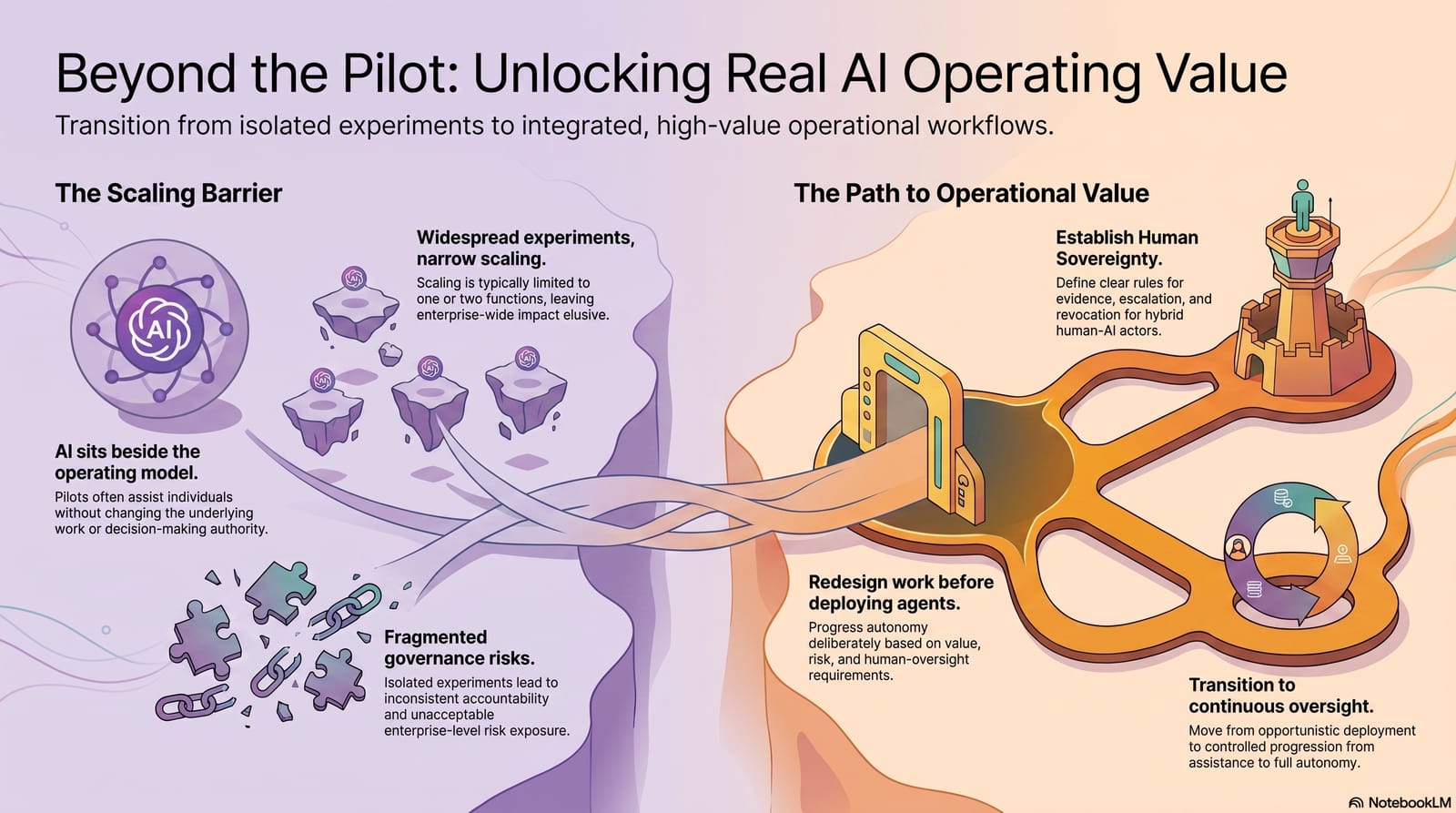
Map capabilities, redesign the work and progress autonomy deliberately. In practical terms, each capability can move to the autonomy level justified by its value, risk and human-oversight needs.
- Fewer disconnected pilots; stronger workflow-level value; clearer path from experimentation to enterprise scale
- Clear autonomy and authority boundaries
- More credible AI value cases
- Continuous evidence and oversight
- Controlled progression from assistance to autonomy
- Which AI pilots changed an end-to-end workflow?
- What operating-model constraint prevents scale?
- How are pilot outcomes compared across capabilities?
- What evidence must an agent produce before its action is accepted?
- Under what condition must authority return immediately to a human decision-maker?
McKinsey reports widespread experimentation with AI agents but much narrower scaling, usually limited to one or two functions.
McKinsey: The State of AI 2025
NIST provides a use-case-and risk-based framework for governing, mapping, measuring and managing AI risk across the system lifecycle.
NIST: AI Risk Management Framework