Decide where AI agents should act
In your words: “We cannot decide where agents should act”
- Agentic use-case selection
- Process readiness for AI
- Agent scoping
The organisation has no shared method for selecting appropriate autonomy by capability. This becomes most visible when pilots move from assisting individuals to making or executing decisions inside operational workflows.
A shared method for choosing the right autonomy by capability replaces a yes or no debate with a clear, justified target for each one.
Value is released early in lower-risk work, and higher-judgement work gets the safeguards it needs before it advances.
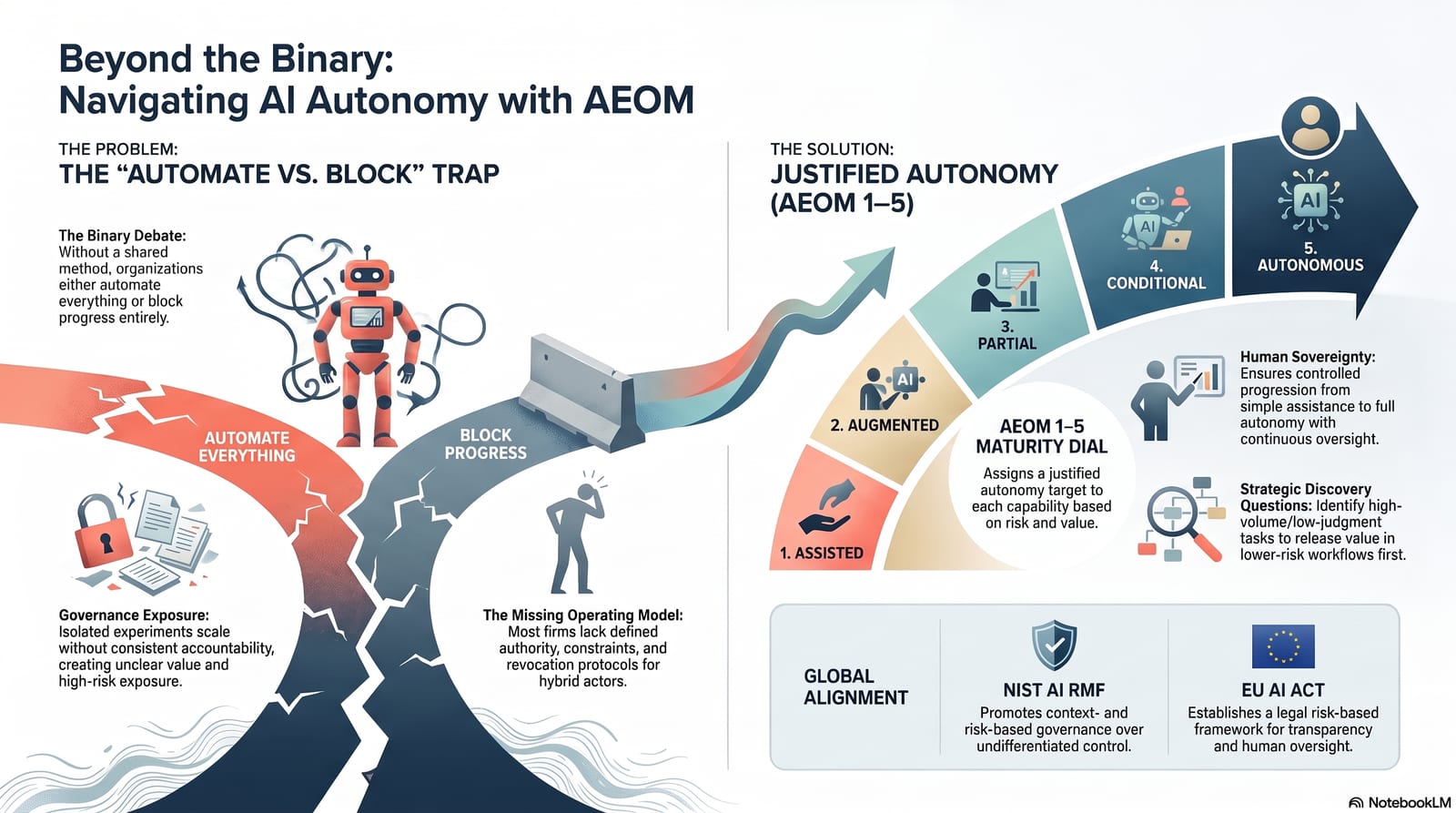
A staged scale of operating modes sets a justified target for each capability. In practical terms, each capability can move to the autonomy level justified by its value, risk and human-oversight needs.
- Faster agreement on appropriate autonomy; value released in lower-risk work without overexposing high-judgement capabilities
- Clear autonomy and authority boundaries
- More credible AI value cases
- Continuous evidence and oversight
- Controlled progression from assistance to autonomy
- Which capabilities are high-volume and low-judgement?
- Which decisions demand human review or accountability?
- What evidence would justify moving a capability up one stage?
- What evidence must an agent produce before its action is accepted?
- Under what condition must authority return immediately to a human decision-maker?
NIST promotes context-and risk-based AI governance rather than a single undifferentiated control approach.
NIST: AI Risk Management Framework
The official EU AI Act establishes a risk-based legal framework covering governance, documentation, transparency, monitoring and human oversight for relevant AI roles and systems.
EUR-Lex: Regulation (EU) 2024/1689