Turn your consulting IP into a reusable operating model
In your words: “Too much of our consulting IP lives in individual consultants rather than a reusable operating model”
- Consulting IP reuse
- Delivery standardisation
- Scalable methodology
Diagnostics, models, reports and workflow solutions are assembled differently for each client. This becomes most visible when the organisation or consultancy needs repeatable process capability but cannot justify enterprise-stack cost, complexity or bespoke delivery for every engagement.
When consultant knowledge lives in a reusable operating model, it can be standardised, reused and built on. Each engagement starts from a proven method, not a blank page.
Delivery becomes repeatable, clients receive consistent artefacts and the method becomes a defensible point of difference with room for recurring value.
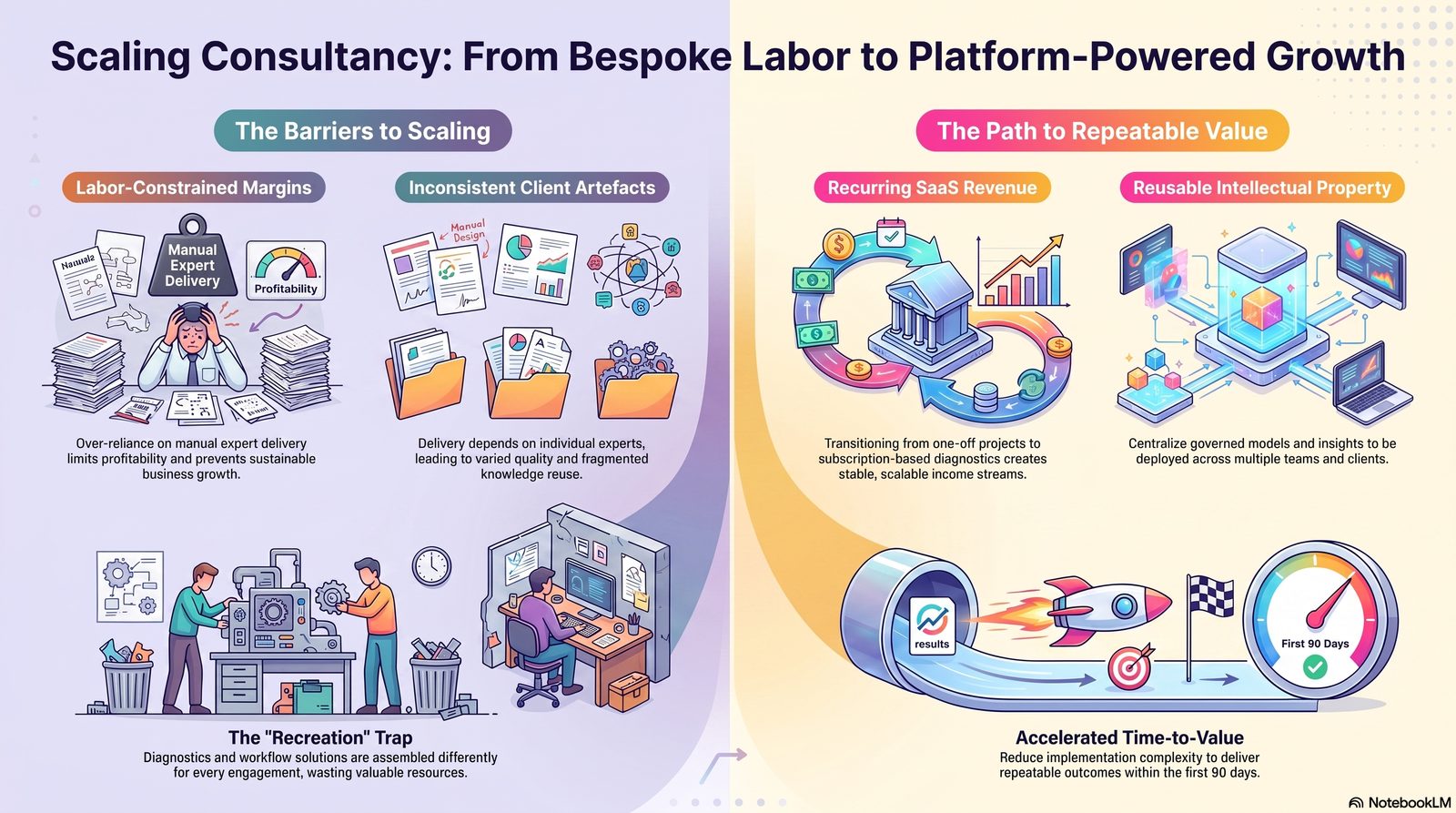
A multi-capability platform supports repeatable diagnostics, governed models, insights and automation. In practical terms, capability can be introduced progressively, reused across teams or clients and governed without recreating the delivery model each time.
- More repeatable delivery, reusable intellectual property, improved margins and potential recurring SaaS revenue
- Lower adoption and delivery complexity
- Reusable methods, content and diagnostics
- Faster time to repeatable outcomes
- A platform for scalable service and recurring value
- Which deliverables are recreated on every engagement?
- Where could a diagnostic become a subscription service?
- How consistently can clients interrogate and act on the model after handover?
- Which part of delivery is recreated for every team or client?
- What minimum governed capability would create value in the first phase?
The report supports the need for tailored, accessible delivery models that reduce implementation complexity for SMEs, the clients many consultancies serve.
UK Government: SME Digital Adoption Taskforce Final Report
APQC defines end-to-end processes as cross-functional work connecting all steps required to achieve a shared outcome, rather than a collection of functional activities.
APQC: End-to-End Processes