Find which processes are safe to hand to AI agents
In your words: “We want to introduce AI agents but do not know which processes are safe to hand over”
- Agentic readiness
- Safe automation handover
- Staged autonomy
Leadership understands the destination but lacks a staged transition mechanism. This becomes most visible when pilots move from assisting individuals to making or executing decisions inside operational workflows.
A staged transition turns a leap into controlled capability change, one capability at a time.
The organisation moves at the pace its evidence supports, neither stalled nor over-committed to autonomy that is not ready.
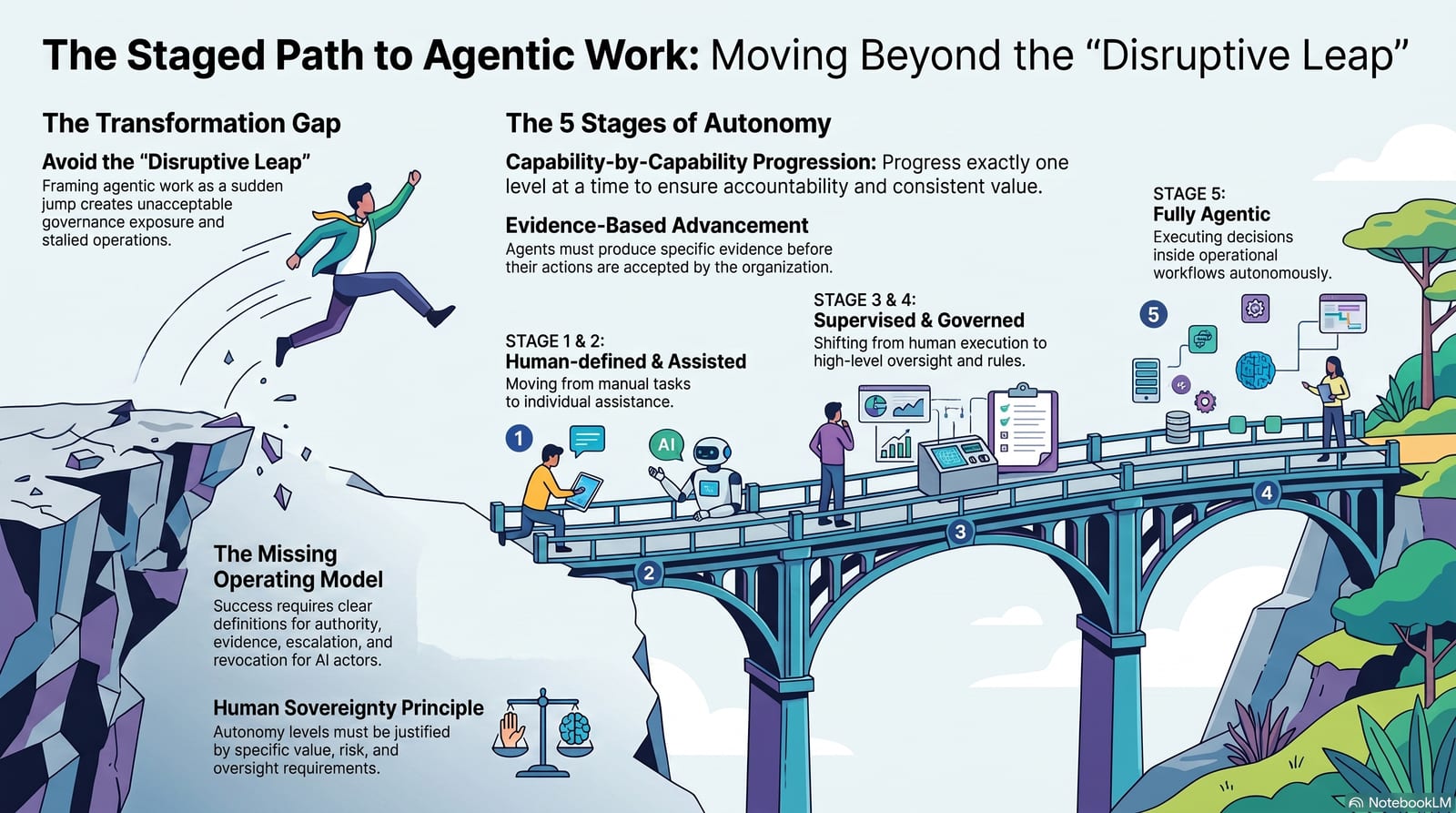
Progress capability by capability through stages from human-defined to fully agentic. In practical terms, each capability can move to the autonomy level justified by its value, risk and human-oversight needs.
- A controlled, capability-by-capability transformation path that avoids both paralysis and reckless adoption
- Clear autonomy and authority boundaries
- More credible AI value cases
- Continuous evidence and oversight
- Controlled progression from assistance to autonomy
- What stage is each priority capability at today?
- What must change to advance exactly one level?
- Which capabilities should intentionally remain at a lower stage?
- What evidence must an agent produce before its action is accepted?
- Under what condition must authority return immediately to a human decision-maker?
McKinsey frames agentic transformation as an operating-model change spanning governance, workforce, technology/data and the business model.
McKinsey: The Agentic Organization
NIST provides a use-case-and risk-based framework for governing, mapping, measuring and managing AI risk across the system lifecycle.
NIST: AI Risk Management Framework