Make accountability clear for every AI decision
In your words: “If an AI agent makes a decision, we are unclear who is accountable”
- Agent authority
- Accountability
- Human oversight
Agents are introduced without explicit delegation, constraints, escalation or evidence requirements. This becomes most visible when pilots move from assisting individuals to making or executing decisions inside operational workflows.
Explicit delegation, constraints, escalation and evidence requirements make it clear what an agent may decide, when it must stop and who remains accountable.
Decisions are consistent, exposure to privacy and security issues is managed and trust in AI grows because people can see the limits.
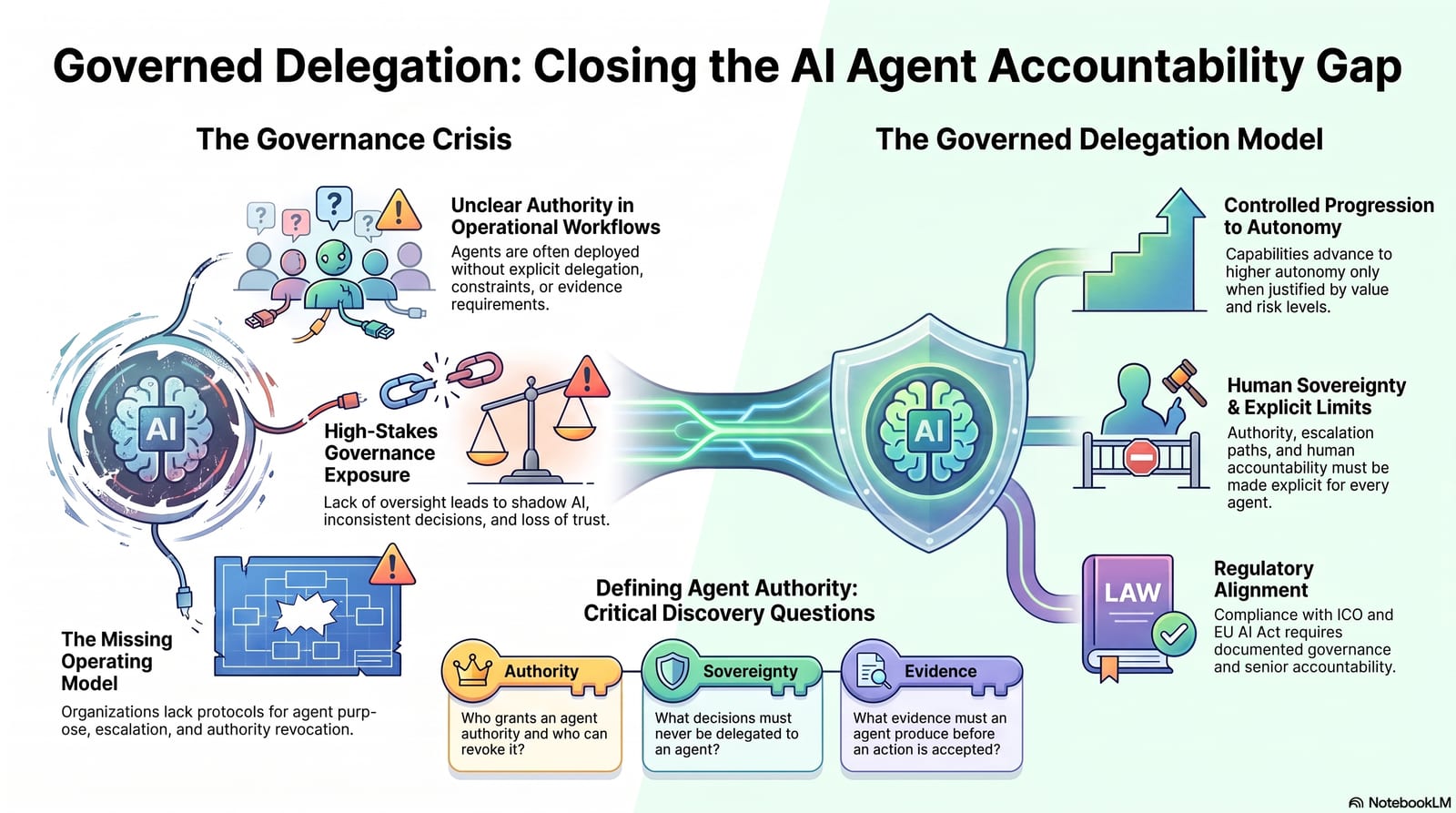
Explicit authority, limits, evidence and accountability for each capability. In practical terms, each capability can move to the autonomy level justified by its value, risk and human-oversight needs.
- Clear delegation, escalation, revocation, evidence and human accountability for agent behaviour
- Clear autonomy and authority boundaries
- More credible AI value cases
- Continuous evidence and oversight
- Controlled progression from assistance to autonomy
- Who grants an agent authority and can revoke it?
- What decisions must never be delegated?
- Where is the evidence of an agent decision retained?
- What evidence must an agent produce before its action is accepted?
- Under what condition must authority return immediately to a human decision-maker?
The ICO expects documented, embedded AI governance, senior accountability and clear risk-management arrangements.
ICO: Governance and Accountability in AI
The official EU AI Act establishes a risk-based legal framework covering governance, documentation, transparency, monitoring and human oversight for relevant AI roles and systems.
EUR-Lex: Regulation (EU) 2024/1689