Turning Consulting Expertise into a Repeatable Platform
Consultancies that build diagnostics, models and reports once and reuse them tie margins to method, not billable hours. This episode covers how to productise expertise into a repeatable, governed platform when a firm needs process capability that scales.
Episodes feature AI-generated hosts discussing human-written IGX360 research.
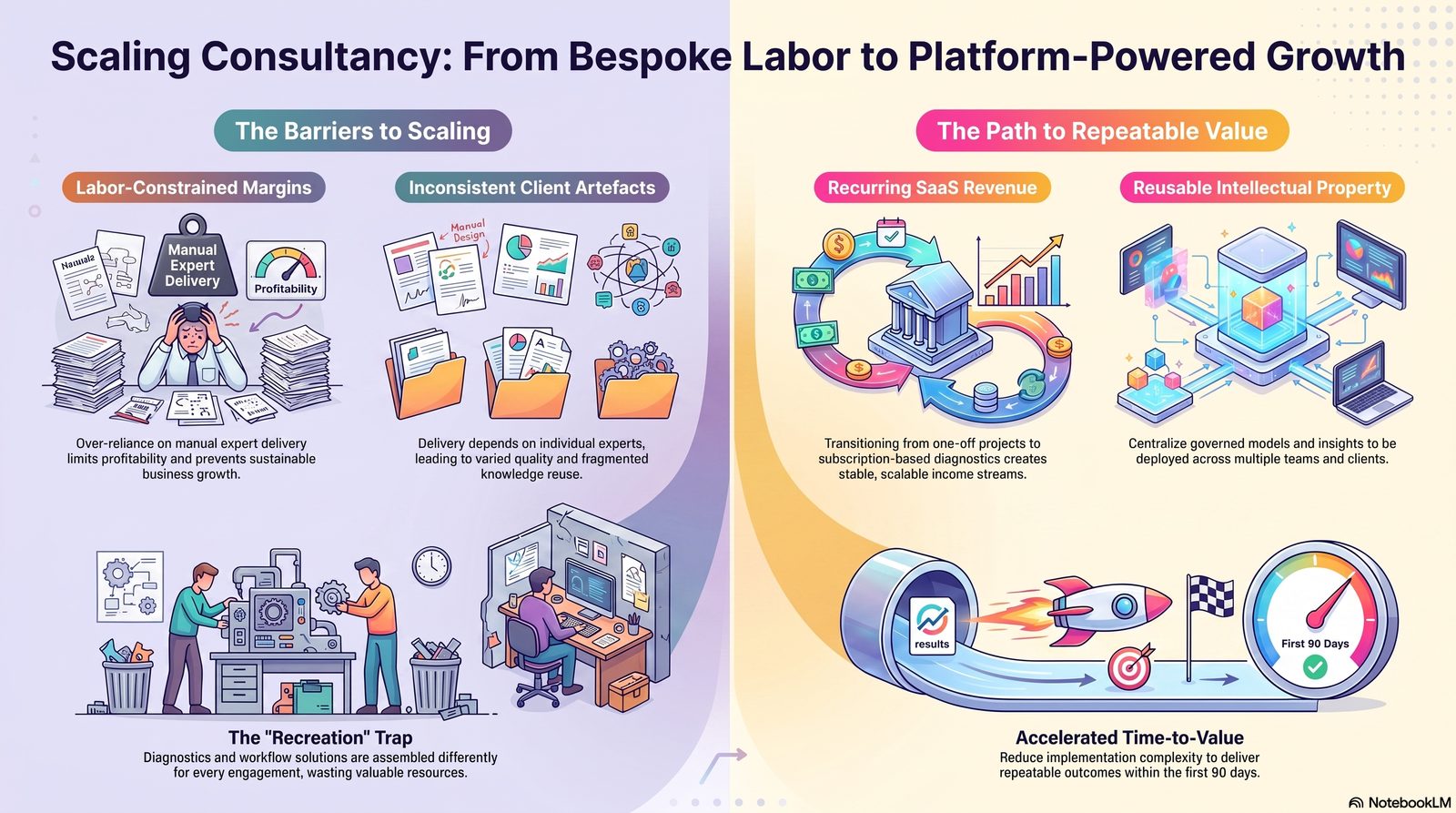
Consultancies are full of skilled experts, and the opportunity is to make that skill repeatable. When every engagement starts from a blank page, diagnostics, models, reports and workflow solutions are rebuilt for each client and only fragments carry over from the last project. This episode covers how a firm gets from that starting point to a repeatable process capability: margins no longer tied to billable hours, differentiation you can defend, and growth that is not capped by how many hours people can physically work.
Drawing on the UK Government’s SME Digital Adoption Taskforce, which supports tailored, accessible delivery models that reduce implementation complexity, and APQC’s definition of end-to-end processes as cross-functional work, the conversation sets out the route: a multi-capability platform supporting repeatable diagnostics, governed models, insights and automation. IGX360 Insights gives consultancies a way to turn expertise into a governed, reusable service, with the ownership, provenance and freshness of each asset visible, so the next engagement starts from what you already know.
Read the full transcript
Host: What if the very thing that makes elite consultants so incredibly expensive, their brilliant, bespoke, customised brainpower, is actually the exact reason their business models are fundamentally broken?
Co-host: I know, it sounds like a total contradiction, right? Because we're just so conditioned to believe that high value means building something entirely from scratch, specifically for one client every single time. We really idolise that whole artisan mindset.
Host: We really do. We picture this master watchmaker, hunched over a workbench for months.
Co-host: But when you step into the high-stakes world of modern knowledge work, specifically management consultancy, treating every client like a unique snowflake suddenly becomes a massive, creeping liability.
Host: Exactly. It's a huge bottleneck. So today we're taking a deep dive into a really fascinating internal diagnostic document. It's titled P10: Our Consultancy Delivery Is Hard To Scale.
Co-host: Yeah, and it serves as this brilliant piece of self-reflection for the industry. The document uses this classic framework called SPIN.
Host: Oh, right. Situation, Problem, Implication, Need-payoff.
Co-host: Yep, that's the one. And it uses SPIN to dissect one of the biggest, most silent bottlenecks in the entire knowledge economy.
Host: So our mission for this deep dive is to explore what we can call the Consultancy Trap. We're going to look at why rooms full of brilliant, highly paid experts get stuck on this hamster wheel of unscalable delivery.
Co-host: And, more importantly, how they can transform that hard-earned knowledge into a scalable, recurring platform.
Host: Exactly. And hey, if you're listening to this right now thinking, well, I'm not a consultant, so I don't care, just think about your own week. How many emails, reports or project plans do you write entirely from scratch that could just be a standardised template?
Co-host: Oh man, probably way too many.
Host: Right. So this deep dive is fundamentally about how to stop reinventing the wheel in your own work. Okay, let's unpack this, starting with the situation and the problem outlined in the source. What does the day-to-day reality actually look like inside these firms?
Co-host: Well, the day-to-day reality in these consultancies is a bit like Groundhog Day.
Host: Groundhog Day.
Co-host: Just with a different corporate logo on the slide deck. The source outlines that diagnostics, models, reports and workflow solutions are assembled differently for every single client.
Host: Wow, every single one.
Co-host: Pretty much. Whenever a new engagement starts, the team essentially opens up a completely blank document.
Host: That sounds exhausting.
Co-host: It is. I mean, maybe they salvage bits and pieces from a past project, but they're fundamentally building the process from scratch while they're simultaneously trying to execute it.
Host: Okay, so it's like a brilliant custom tailor, making these incredible one-of-a-kind suits. But wait, I've got to push back on this for a second.
Co-host: Okay, go for it.
Host: If I'm a Fortune 500 company hiring a high-end consultancy, I'm paying top dollar specifically so I don't get the off-the-rack solution. So why is it a problem that they're treating every client as unique? Isn't bespoke, custom delivery exactly what clients are paying for?
Co-host: I mean, that is the exact cognitive dissonance that keeps these firms completely stuck.
Host: Really? How so?
Co-host: Well, the bespoke approach is wonderful if you have infinite time and an instant budget, but the document clarifies exactly when this breaks down. And that's the moment a consultancy needs a repeatable process capability.
Host: Okay. So they hit a wall.
Co-host: Exactly. They find themselves trapped in this terrible middle ground. On one hand, they can't justify the massive cost and complexity of an enterprise tech stack.
Host: Right, they can't just build custom software for every single client.
Co-host: Exactly. Nor can they justify bespoke manual delivery for every single engagement if they actually want to scale.
Host: I see. So they lack this kind of middle gear.
Co-host: Because there's no governed, reusable model, which is the core problem. We need to look at the collateral damage this causes, and the ripple effects are pretty stark. The source outlines that margins remain severely constrained by labour, plus clients end up receiving highly inconsistent artefacts.
Host: Oh, right, because it's just human labour.
Co-host: Exactly. And, most dangerously, their differentiation becomes incredibly hard to defend. At an enterprise scale, these methods rely entirely on individual experts and static documents.
Host: And I'm assuming that severely limits adoption, reuse and any recurring value.
Co-host: Oh, absolutely. What's fascinating here is the irony of it all. I mean, think about it. Consultants are literally hired to go into other businesses to streamline operations and find efficiencies.
Host: Oh wow, yeah.
Co-host: Yet they suffer from these wildly inefficient internal dependencies on experts and documents.
Host: That's wild.
Co-host: It just goes to show how painful it must be for a firm's growth when their profit margins are completely tethered to how many hours their staff can physically stay awake.
Host: Yeah, you literally can't make more money unless you hire more people or force your current team to work eighty-hour weeks.
Co-host: So labour is this unscalable trap.
Host: How do these firms break out without buying an insanely expensive enterprise system? This leads us straight to the solution, right?
Co-host: Yes. The source's need-payoff introduces this idea of a multi-capability platform.
Host: Okay, what does that actually look like?
Co-host: Well, it's a platform that supports repeatable diagnostics, governed models, insights and automation.
Host: Got it. So they're moving away from the blank document.
Co-host: Exactly. And the benefits are massive. You get reusable intellectual property, much lower adoption and delivery complexity, and faster time to repeatable outcomes.
Host: And the margins must improve too, right?
Co-host: Oh, hugely improved margins. And it opens up the holy grail, which is potential recurring...
Host: Software as a service.
Co-host: Software as a service. Here's where it gets really interesting. It's like shifting from being a personal chef who has to cook in a different kitchen every single night and buy all the groceries from scratch, to creating a scalable, governed meal-kit subscription service that anyone can follow.
Host: I love that analogy.
Co-host: That's exactly it. You're literally productising your expertise.
Host: Yeah, and the psychological shift required here is massive. You're moving from selling time and documents to selling a scalable platform, and you don't even have to recreate the delivery model every single time.
Co-host: Crucially, no. This capability can be introduced progressively and then reused across teams.
Host: Okay, but to prove this isn't just some niche theory that we're obsessing over, we should look at how external authorities validate this.
Co-host: Yeah, the source actually provides two very solid pieces of external validation for this exact need.
Host: Okay, what's the first one?
Co-host: The first one is from the UK government, their SME Digital Adoption Taskforce final report.
Host: SME being small and medium-sized enterprises, right?
Co-host: Yes, exactly. And the report explicitly supports the need for tailored, accessible delivery models that reduce implementation complexity for SMEs.
Host: Which makes sense, because a fifty-person company isn't going to have a massive IT team to handle complex tech, right?
Co-host: Exactly. And the second piece of validation comes from APQC, the American Productivity and Quality Center.
Host: Okay, and what do they say about it?
Co-host: Well, they define end-to-end processes as cross-functional work connecting all the steps required to achieve a shared outcome, rather than just a collection of siloed functional activities.
Host: Siloed functional activities, so basically just throwing a massive PDF report over the fence, to the HR department.
Co-host: Right. If we connect this to the bigger picture, the APQC definition proves that consultancies can't just hand over a static document of isolated advice. They need something that actually connects the dots across the whole company, a platform that supports a true, cross-functional, end-to-end outcome.
Host: Okay, so we've established the problem, which is the bespoke trap. We've talked about the solution, this multi-capability platform, and we have the external proof. Now, how does a consultancy actually begin this transition?
Co-host: Yeah, that's the big question. And the source outlines it by asking five very specific discovery questions.
Host: Let's run through these, because this is where the rubber meets the road. Question one: which deliverables are recreated on every engagement?
Co-host: Right, so this is about looking at your daily operations. What spreadsheet or presentation does your team rebuild from scratch every single time a new client signs on?
Host: The ultimate copy-paste nightmare.
Co-host: Exactly. You find that, and you lock that logic into a governed digital template.
Host: Love that. Okay, question two: where could a diagnostic become a subscription service?
Co-host: This is all about recurring revenue. If you do an annual audit and hand over a static report, how could you turn that into a live, interactive dashboard?
Host: Right, so instead of paying you once a year, they pay a monthly SaaS fee to keep using that dashboard.
Co-host: Yes, exactly. Okay, question three: how consistently can clients interrogate and act on the model after handover?
Host: This raises an important question, honestly, because if a client can't use the model after the consultant leaves...
Co-host: The consultant has essentially failed to deliver lasting value.
Host: Oh wow.
Co-host: Yeah, if they're too scared to break the Excel formula, it's just a dead document.
Host: Precisely. A governed platform gives them a safe, easy interface to keep using those insights.
Co-host: Makes total sense. All right, question four: which part of delivery is recreated for every team or client?
Host: This one looks inward. It's asking where you're reinventing your own internal plumbing, like your own data-gathering or onboarding processing.
Co-host: You've got to standardise the internal stuff too, not just what the client sees.
Host: Exactly, unify it on the platform. And finally, question five: what minimum governed capability would create value within the first ninety days?
Co-host: Yeah, because you can't just disappear into a basement for two years to build the perfect software, or you'll go out of business.
Host: You have to find the smallest, most impactful piece of your process, govern it, and get it out there fast to prove the value.
Co-host: So what does this all mean for you, the listener? Look at your own workflows. Ask yourself these five questions.
Host: Where are you acting like that bespoke artisan tailor, just painstakingly recreating work from scratch?
Co-host: It's so true. Finding those tasks is the first step to scaling your own impact.
Host: Exactly. So, to wrap things up, we've gone on quite a journey in this deep dive. We've explored this really necessary evolution from a bespoke, labour-constrained consultancy to a repeatable, platform-driven SaaS model.
Co-host: Yeah, moving from the artisan tailor to the scalable platform. And the source has a very clear final call to action, right?
Host: It does. It highly recommends booking a call to identify which of your consultancy methods can become a repeatable SaaS proposition, specifically using their IGX360 platform.
Co-host: Which makes sense, as it's designed to help handle this exact transition.
Host: Exactly. But before we go, I want to leave you with one final, kind of provocative thought based on all of this.
Co-host: All right, let's hear it.
Host: So, as artificial intelligence begins to commoditise basic knowledge work and automated reporting, the exact stuff these consultants usually do manually, productising your unique expertise into a scalable, interactive platform isn't just a way to increase margins. It might be the only way human experts survive the next decade.
Co-host: Wow. Yeah, because if an AI can do the bespoke manual labour instantly, you really have to be the one who owns the governed system.
Host: That is a massive thought to end on. Thanks for joining us for this deep dive, everyone.
Co-host: We'll catch you next time.
Want to see what this looks like on your own process architecture? One conversation is enough to start.