Moving Manual Coordination into Digital Workflows
People coordinate recurring work across inboxes, trackers and meetings. This episode covers how a governed digital workflow gives everyone live status, clear responsibility and an evidence record as work crosses team boundaries.
Episodes feature AI-generated hosts discussing human-written IGX360 research.
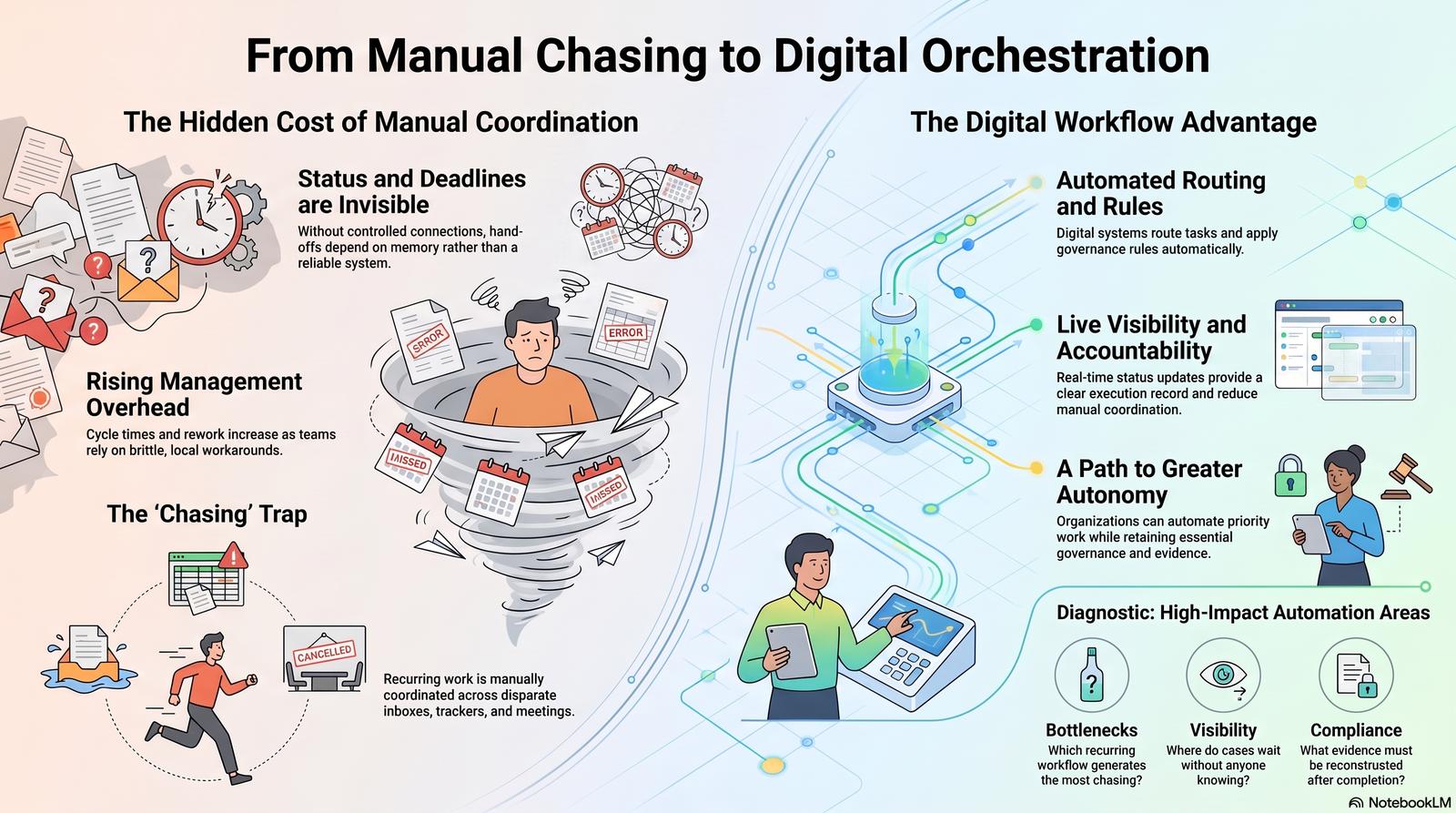
Your job is more than chasing status updates over email and hunting through spreadsheets for who owns what. This episode covers how to move from manual coordination to governed digital workflow, what it gives back in cycle time, less rework and retained evidence, and why governance and autonomy work together: a governed workflow is what frees people from the anxiety of manual coordination.
Drawing on Microsoft’s 2025 Work Trend Index and ISO 9001’s process approach, the conversation shows why high interruption volume points to the structure of the work rather than the effort of the people, and how a workflow that routes tasks, applies rules and captures evidence automatically replaces email chains and hidden spreadsheets with a live, auditable record.
Read the full transcript
Host: Have you ever felt like your actual job isn't, well, your job, but rather just chasing people over email and hunting down status updates in giant spreadsheets?
Co-host: Oh, absolutely. It's like that is the defining modern workplace experience right there.
Host: Right. I mean, you log on, you have this clear list of things you want to accomplish, the things you actually have expertise in, and suddenly it's 3pm. You look back at your day and all you've really done is ping colleagues asking, hey, did you look at that attachment? Where are we on the approval for this project?
Co-host: It's exhausting. I mean, we are hired for our specialised skills, but we spend our days playing this very high-stakes, deeply exhausting game of digital ping pong.
Host: Digital ping pong, exactly. And we just accept that this is what work looks like now.
Co-host: You know, the cognitive load of simply keeping track of who is supposed to be doing what has entirely eclipsed the work itself.
Host: Well, today we are going to challenge that acceptance. We are taking a deep dive into this fascinating internal document, simply but perfectly titled, 'P6: Work Is Managed Through Email, Spreadsheets, and Chasing.'
Co-host: Such a great title.
Host: It really is. And the text we're unpacking uses something called the SPIN framework. So it's situation, problem, implication, need-payoff.
Co-host: Right, the diagnostic lens.
Host: Exactly. It uses that lens to look at this business pain, and it actually backs up its claims with external data from Microsoft and ISO.
Co-host: Which is an incredibly effective way to examine the problem. I mean, it takes that vague, pervasive feeling of workplace burnout and gives it a highly specific structural vocabulary.
Host: We can finally stop looking at this as a personal time-management failure and start looking at the anatomy of an operational breakdown.
Co-host: So our mission for this deep dive is to unpack the hidden structural costs of all this manual work coordination. We want to figure out why our daily processes feel so hopelessly broken, and we want to look at the actual roadmap to fixing them without just adding more chaotic software to the pile.
Host: Because I guarantee nobody listening wants another app that just sends them more push notifications.
Co-host: Oh, please, no more notifications.
Host: Okay, let's unpack this. Before we can fix the chaos, we need to diagnose what's actually happening on the ground when work crosses team boundaries.
Co-host: The source document lays out the reality pretty bluntly, actually. It says people coordinate recurring work manually across inboxes, trackers, and meetings. A crucial detail in the source material, though, the thing that really exposes the root of the issue, is what happens specifically when a task has to cross over into different teams and approval systems.
Host: Okay, so when it leaves your immediate desk.
Co-host: Exactly. The document notes that execution is coordinated outside the approved process model.
Host: Outside the approved process model. So I mean, management has this beautiful, colourful flow chart sitting on a server somewhere, but the actual work is happening in the shadows.
Co-host: Yeah, let's consider the operational fallout of that reality, because when the work is happening outside the official model, your visibility into status, responsibility, and deadlines just drops to zero.
Host: Wow.
Co-host: And the most precarious part of this entire setup, handoffs between departments depend almost entirely on human memory.
Host: Just remembering to do it.
Co-host: And the document explicitly points out that the underlying weakness here is the absence of a controlled connection between process design, executable work, decision rights, and runtime evidence.
Host: Exactly. But let me push back on this for a second, or at least play devil's advocate here. Aren't spreadsheets and emails just the normal way business gets done?
Co-host: I mean, sure, they're ubiquitous.
Host: Right. Every company in the world runs on shared Excel files and endless email chains. It kind of feels a bit like we are critiquing water for being wet.
Co-host: That's a fair point. I'm picturing it like this. It's like management has designed a beautiful state-of-the-art highway on paper.
Host: That's the official process design.
Co-host: It's got clearly marked lanes, signs, speed limits.
Host: A perfect system.
Co-host: Right. But out in the real world, everyone is just off-roading through the mud in their own vehicles, forging their own paths to get to the destination.
Host: That executable work is just muddy, messy reality. Isn't that just human nature taking the path of least resistance?
Co-host: What's fascinating here is where that reliance on human memory becomes the absolute breaking point.
Host: Your off-roading analogy is perfect for illustrating the structural flaw, actually.
Co-host: Really? How so?
Host: Well, yes, an individual driver might successfully navigate the mud once or twice, or even every day for a year. But what happens when that specific driver goes on vacation? Or what happens when a hundred drivers are all off-roading in different directions, crossing paths blindly in the dark?
Co-host: Exactly. Human memory is incredibly fallible. When handoffs depend on someone saying to themselves, oh, I need to remember to email Sarah in accounting when John from legal finishes his part, you are essentially building your entire operational infrastructure on a foundation of cognitive overload.
Host: Man, yeah. You're relying on someone not having a bad night's sleep or not having their kid home sick from school. The moment their memory slips, the entire workflow just halts.
Co-host: The process design we mentioned exists for a fundamental reason. It establishes decision rights, which means the organisation knows exactly who is authorised to approve what step based on risk and compliance. And it establishes runtime evidence, that immutable audit trail proving the work was done correctly and compliantly at the exact moment it happened.
Host: Okay, so when you off-road through email and custom spreadsheets, you completely abandon that.
Co-host: Completely. Suddenly a critical financial approval happens with a quick 'looks good' in a Slack message from someone who might not even have the authorisation.
Host: Oh wow, yeah.
Co-host: And you entirely lose the runtime evidence. You have no audit trail other than a tangled web of forwarded emails that someone has to manually piece together later.
Host: So if that is the baseline reality for individuals, what happens when this local off-roading scales up to the entire enterprise? I mean, we move from a daily annoyance for one employee to a massive systemic risk for the company.
Co-host: Yeah, that's exactly what the document outlines in the implications phase. It breaks it down pretty starkly. Cycle time goes up, rework goes up, errors and management overhead rise, and as you just mentioned, the evidence of work done becomes completely incomplete.
Host: Let's look mechanically at why rework goes up in this environment.
Co-host: Because when everyone is off-roading, local workarounds and mini automations begin to multiply across the enterprise.
Host: What do you mean by mini automations?
Co-host: One department might use a specific web-based project management board. Another department might rely on an incredibly complex, macro-heavy spreadsheet to track their pipeline. You know, a spreadsheet that only one guy named Steve understands.
Host: Oh man. Every company has a Steve and his magical, fragile spreadsheet.
Co-host: They absolutely do. And when Steve goes out on medical leave, his backup doesn't know the exact undocumented order of operations required to make that spreadsheet function.
Host: So crucial steps get skipped, the data gets corrupted, the handoff to the next team is fumbled, and an entire week's worth of work has to be redone from scratch.
Co-host: The source text points out the specific outcomes of all these multiplying workarounds. You get what they call brittle handoffs, inconsistent controls, and an increasingly expensive change estate.
Host: Let's build on that off-roading analogy to understand the expensive change estate thing.
Co-host: If everyone is forging their own paths, it's like every department is building their own secret, duct-taped bridges over a river to get their specific job done.
Host: I love that visual.
Co-host: Thanks. So the accounting team has a bridge made of Google Sheets and text messages. The engineering team has a bridge made of Jira tickets and Slack DMs. But when one of those bridges breaks, which the document calls a brittle handoff, nobody knows how to fix it because there's no official blueprint.
Host: There's no engineering schematic for a Slack thread.
Co-host: Exactly. So making any structural change to the way the company operates becomes incredibly expensive.
Host: If we connect this to the bigger picture, that concept of an expensive change estate is the silent killer of enterprise agility.
Co-host: Let's say a company needs to pivot. Maybe a new data privacy regulation passes, or they want to adopt a completely new business model. If your processes are governed by a central, visible system, you update the rules within that system.
Host: That makes sense.
Co-host: But if your processes are actually just a chaotic web of emails, hidden spreadsheets, and local workarounds, changing your business model means you have to somehow find, untangle, and rebuild thousands of invisible, duct-taped bridges. You'd have to interview fifty different people just to figure out where their customer data even lives.
Host: Exactly.
Co-host: The cost of change becomes astronomical simply because the organisation doesn't actually know how it operates on a granular level.
Host: It's terrifying when you realise the scale of the blind spot. It's not just that chasing emails is annoying. It's that chasing emails is actively making the company unsteerable.
Co-host: Yeah, unsteerable is a great word for it. And this feeling of structural chaos isn't just an anecdotal workplace gripe. The source document backs this up with some major external validation.
Host: Right, the data.
Co-host: We have two very different, but very complementary pieces of external data proving that this is a structural crisis. The document first points to Microsoft's 2025 Work Trend Index. This is quantitative data looking at how we actually spend our time.
Host: And the Microsoft research reports sustained capacity pressure and high interruption volumes, specifically from email, meetings, and chat.
Co-host: They are explicitly supporting the case for better workflow orchestration because we are quantitatively drowning in digital interruptions.
Host: We can view that interruption volume as a direct proxy for broken processes. I mean, every time you have to context-switch to answer a chat ping asking for a status update, you burn cognitive energy.
Co-host: Definitely. And then on the completely opposite end of the spectrum from the modern Microsoft data, the document brings in ISO 9001.
Host: The classic foundational standard for quality management.
Co-host: Right. ISO explains that managed processes and their interactions are what actually support consistent results, performance evaluation, and continual improvement. They refer to this through the process approach and the PDCA cycle.
Host: Which stands for Plan, Do, Check, Act.
Co-host: Exactly. Here's where it gets really interesting. Look at the striking contrast we have here. On one side, we have the high-tech, hyper-modern reality of crushing digital interruptions from the Microsoft 2025 report.
Host: The pings and notifications.
Co-host: Yeah, it's the Slack pings, the Teams notifications, the relentless influx of emails that define our modern workday.
Host: But on the other side, that modern chaos is clashing directly with the classic necessity of structured process management laid out by ISO 9001.
Co-host: It's a fundamental conflict. Let's think mechanically about how that PDCA cycle completely breaks down when there is no runtime evidence.
Host: You have plan, designing the process, then you have do, executing the work, then check, measuring the results, and finally act, improving the process.
Co-host: You cannot possibly have a functional plan-do-check-act cycle if the do and the check are buried in a hundred different chat threads and lost emails.
Host: You can't continually improve a process that you can't even see.
Co-host: No, you can't. I want you listening right now to think about how universal this problem is. You are likely feeling that sustained capacity pressure today, because if the execution happens in shadow IT, like in personal inboxes and hidden spreadsheets, the check phase of ISO is literally impossible.
Host: You can't measure cycle time if you don't have timestamps for when handoffs occurred.
Co-host: And that constant pressure you feel is the direct result of the lack of a managed process. Because you don't have a reliable, visible system telling you the status of a project, you are forced to interrupt someone else to find out.
Host: And because they don't have a visible system, they have to interrupt a third person. It's a chain reaction.
Co-host: It really is. That Microsoft data regarding high interruption volumes isn't a sign that people are working hard and being highly collaborative.
Host: It's a symptom of a broken operational structure. It is the sound of people desperately trying to keep the duct-taped bridges from collapsing.
Co-host: So if the data proves we are drowning in manual interruptions, how do we finally bridge the gap between our official process designs, that beautiful state-of-the-art highway, and the actual daily executable work?
Host: Well, the document introduces a very clear digital workflow solution that routes tasks, applies rules, captures evidence, and provides live status.
Co-host: It's about moving away from a manual, memory-based push system, where I have to remember to push a file to you, to an automated, rule-based routing system.
Host: The text gets very specific about the practical terms here. It says the organisation can automate priority work right now while retaining governance, evidence, and a deliberate path toward greater autonomy.
Co-host: Let's look at the specific benefits listed. We are talking about shorter cycle times, fewer missed handoffs, clear accountability, and an automatic execution record.
Host: The system simply builds the audit trail in the background as you do the work.
Co-host: Exactly. It's seamless. Plus, you get visible work status and significantly reduced manual coordination and rework.
Host: The document specifically highlights a product route for this: iGrafx Workflow.
Co-host: That product route represents the exact bridge we've been talking about.
Host: Let's look at what that actually does mechanically.
Co-host: Yeah, walk me through it.
Host: Instead of taking a vendor contract, attaching it to an email, and typing 'please review', you initiate that contract within the iGrafx Workflow portal. The system already knows the approval matrix. It knows that if the contract is over a certain amount, it needs to route to finance. Under that threshold, it routes to procurement.
Co-host: So you don't even have to think about it.
Host: Exactly. The system applies the rule, writes the task, logs the exact timestamp for the audit trail, and alerts the necessary person.
Co-host: You aren't operating outside the model anymore.
Host: The model itself is the engine routing your tasks.
Co-host: I see the connection there, but let me pause you, because there's a phrase in the benefits list that caught my eye. It mentions the governed reuse of workflows and controls.
Host: Oh.
Co-host: I'm actively wondering how a company balances these two competing ideas. I mean, governance sounds inherently restrictive, like corporate red tape telling me exactly how to click my mouse and who to report to.
Host: Right, nobody likes that word.
Co-host: But autonomy sounds freeing, like I have the power to just get my work done on my own terms. How does a digital workflow balance governance with autonomy? Aren't they fundamentally opposites?
Host: This raises an important question, and it's perhaps the most misunderstood concept in organisational design. Governance and autonomy are not opposites. In a well-designed digital workflow, governance actually enables safe autonomy.
Co-host: Walk me through that. Give me a sense of how that feels for the person doing the work.
Host: Think about the highway analogy again. The governance is the infrastructure. It's the painted lines on the road, the speed limits, the traffic lights. Because those rules are universally understood and enforced by the infrastructure itself, you, the driver, have total autonomy. You can listen to the radio, have a conversation with your passenger, and drive from point A to point B without having to constantly negotiate right of way with every single other driver at every single intersection.
Co-host: Well, that makes sense.
Host: Right. If you remove the governance, if you take away the traffic lights and the lanes, you do not get more autonomy. You get a massive, stressful traffic jam where everyone is inching forward, terrified of crashing into each other.
Co-host: That makes so much sense, especially when you consider the daily anxiety of an office job. Without governance, my so-called autonomy is actually just me constantly stressing about whether I'm doing something wrong.
Host: Precisely. Did I use the right version of the template? Did I forget to CC the compliance manager? Is the auditing team going to yell at me six months from now?
Co-host: Exactly.
Host: The governed reuse of workflows and controls means that the rules, the necessary approvals, and the compliance checks are baked directly into the system, like in iGrafx Workflow.
Co-host: So it takes the guesswork out.
Host: The workflow automatically routes the task to the right person, enforces the business rule, and captures the runtime evidence. Because the governance is seamlessly handled by the system, you, the employee, are freed from the anxiety of manual coordination.
Co-host: That's huge.
Host: That is. You have the true autonomy to enter a flow state and do the deep, valuable work you were actually hired to do, knowing the system is keeping you safe and compliant.
Co-host: That is a massive paradigm shift. The structure actually provides the freedom.
Host: And once you realise governance provides freedom, the immediate question becomes, well, how do I apply this to my own chaotic workday?
Co-host: Right. Where do you start?
Host: Exactly. The final section of our source document is designed to make all of this entirely actionable. It includes a set of discovery questions.
Co-host: We are going to hold up a diagnostic mirror to your own daily grind, speaking directly to you, the listener.
Host: I love this part. Let's run through these questions as an interactive thought experiment.
Co-host: Really think about your Tuesday morning, or the end of your month, while we ask these.
Host: I'll start. Question one. Which recurring workflow generates the most chasing?
Co-host: That is a powerful starting point. We aren't looking for the most complex, highly technical workflow. We are looking for the routine, everyday task that generates the most 'just checking in' emails.
Host: Yeah, those are the worst. Question two. Where do cases wait without anyone knowing?
Co-host: The invisible bottlenecks. The black holes in a shared inbox where customer requests go to die until an angry client finally calls to complain.
Host: We've all seen those. Okay, question three, and this is the one I am completely fixated on. What evidence must be reconstructed after completion?
Co-host: That's a painful one. Let's just pause and dwell on this one, because the nightmare of having to reconstruct evidence just to prove you did your job correctly is so visceral. Have you ever spent four hours on a Friday afternoon taking screenshots of old Slack messages, digging through deleted emails, and cross-referencing calendar invites, just to prove to an auditor or a manager that a specific safety process was followed?
Host: It's the worst feeling. It's absolutely soul-crushing. You already did the hard work. Why are you spending hours proving it existed?
Co-host: Because, as we established earlier, the work was done entirely off-road. There was no automatic execution record being built in the background.
Host: Question four addresses the velocity of the business. Which handoff or approval creates the greatest avoidable waiting time?
Co-host: Where is a critical piece of work just sitting in a manager's inbox for three days while they are away at a conference?
Host: And finally, question five. What runtime evidence would demonstrate that the approved process is actually being followed?
Co-host: Not what artefact shows that the final work is done, but what data proves the process itself was followed safely, sequentially, and correctly.
Host: These five questions are brilliant because they bypass software entirely.
Co-host: They ask about friction. They guide you to locate the exact spots where human memory is failing as an operational infrastructure.
Host: As we wrap up this deep dive, let's briefly recap the journey we've just been on. We started in the hidden, incredibly stressful chaos of email and spreadsheet management, a world where our entire work life relies on the fragile thread of human memory, leading to constant digital ping pong.
Co-host: We saw how that local off-roading scales into an expensive, brittle enterprise disaster, and we validated that structural failure using both Microsoft's data on interruption overload and ISO's foundational standard on managed processes, demonstrating how invisible work completely breaks the plan-do-check-act cycle.
Host: Structural solution: moving away from manual coordination to governed digital workflows, like iGrafx Workflow, that capture automatic execution records and provide that beautiful live status visibility.
Co-host: Yeah, getting out of the mud, which leads us to a direct call to action for you.
Host: The source document ends with a prompt, and we want to pass it on to you. Book a call to select the manual workflow with the clearest cycle-time, control and visibility benefit.
Co-host: It's a great next step. Don't try to fix the whole company tomorrow. Don't try to map out every single process. Just use those five discovery questions to identify that one single most painful manual workflow in your own life. Find the one that makes you reconstruct evidence on a Friday afternoon and start there.
Host: Exactly. It is the most pragmatic way to begin dismantling the duct-tape infrastructure.
Co-host: Identify the single biggest source of friction and replace it with flow.
Host: Before we go, I want to leave you with one final lingering thought. There was one specific phrase in the document's benefits list that we didn't fully unpack during our discussion, and it is incredibly provocative.
Co-host: Oh, which one?
Host: It listed a benefit of this digital workflow as providing a safer path from automation to agents.
Co-host: Right, AI agents.
Host: We hear constantly right now about AI agents taking over future work.
Co-host: AI is going to run our schedules. AI is going to negotiate our contracts. AI is going to manage our pipelines. It's all anyone talks about.
Host: But think about everything we just discussed today. If an enterprise tries to unleash advanced AI agents on top of an undocumented, duct-taped foundation of hidden spreadsheets and off-road emails, won't those agents just automate the chaos?
Co-host: If the business itself doesn't actually know how the bridges are built, how can an AI safely cross them?
Host: They can't. If you want an AI-enabled future, don't you first need a digital workflow that actually captures how the work gets done today?
Co-host: If you're still off-roading through the mud, giving an AI the steering wheel isn't going to magically build you a highway. It's just going to crash the car a whole lot faster.
Host: That is such a crucial point to remember. Think about that the next time you have to chase someone down for a status update.
Co-host: Until next time, thanks for taking the deep dive.
Want to see what this looks like on your own process architecture? One conversation is enough to start.