Building an Integrated Platform, Not a Stack of Point Tools
SMEs often buy point tools to solve one problem at a time. This episode covers how a provisioned, integrated SaaS platform connects data across systems, lowers the assembly burden and reduces dependence on a few scarce experts.
Episodes feature AI-generated hosts discussing human-written IGX360 research.
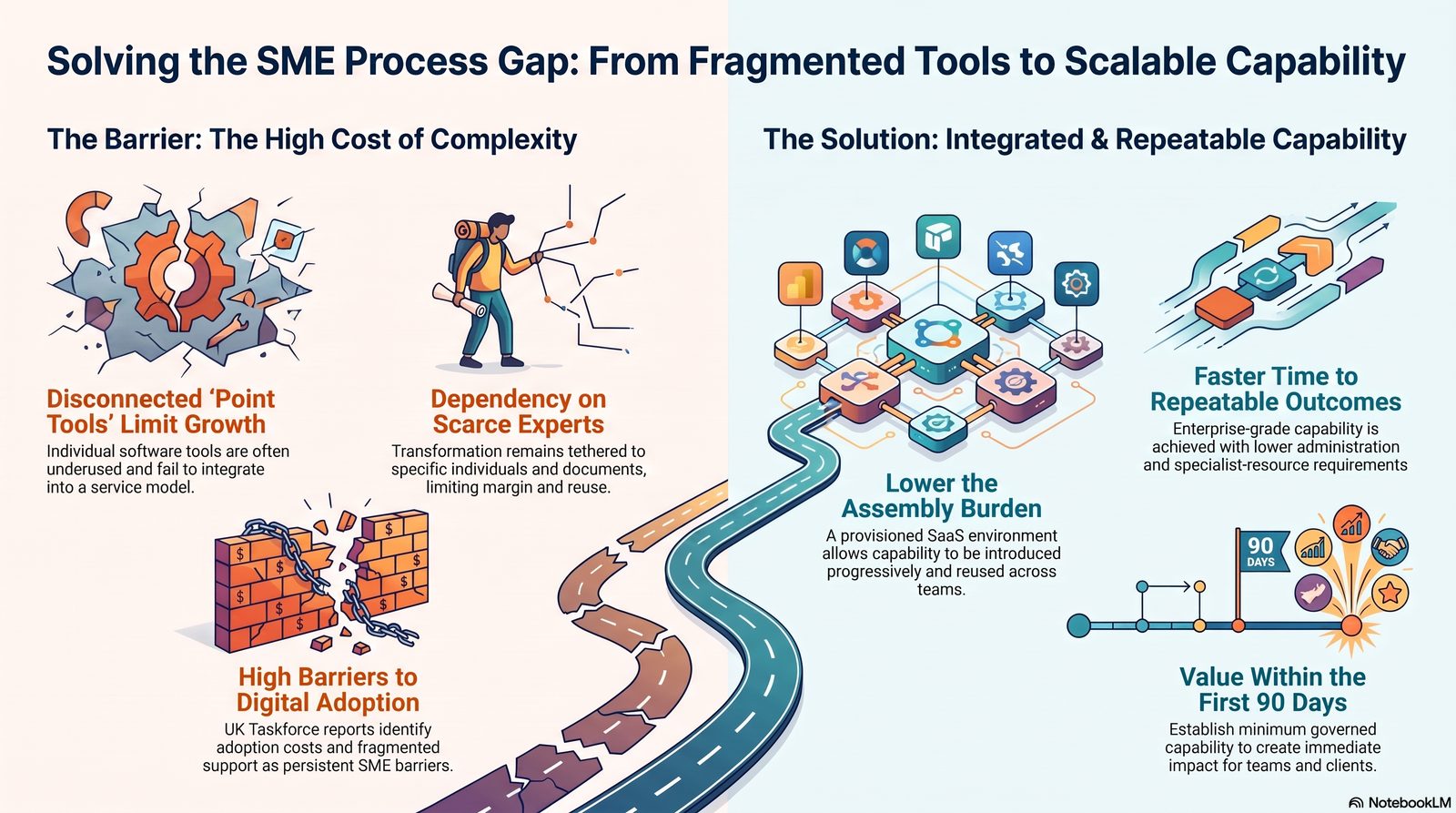
Smaller businesses are keen to adopt software, and the opportunity is to make the tools work together. Each point tool solves one narrow problem, and where nobody owns the connection between them, people copy data by hand from system to system. This episode covers how to get from that starting point to working knowledge that is written down and shared, so the business no longer depends on a handful of experts holding it in their heads, and why adding AI works best once the data is joined up.
Drawing on the UK Government’s SME Digital Adoption Taskforce, which identifies enterprise-oriented products, adoption cost and fragmented support as persistent barriers, and ONS analysis linking technology value to management capability rather than procurement alone, the conversation sets out the alternative: a provisioned, integrated environment where modelling, analysis and execution share one data foundation from day one. IGX360 Insights lets capability be introduced step by step and governed without an enterprise IT department, with clear ownership and freshness on what the business relies on.
Read the full transcript
Host: I want you to picture a scenario that is probably painfully familiar if you've ever worked in a modern office.
Co-host: Oh, I can only imagine where this is going.
Host: Right. So your company identifies this glaring problem. Let's say it's client onboarding, or maybe internal reporting. And the leadership team gets together, they deliberate, and finally, they announce they've purchased this shiny, state-of-the-art new software tool to solve it.
Co-host: Cue the enthusiastic emails.
Host: Exactly. The emails go out, the mandatory training sessions are scheduled. Fast forward six, maybe seven months, and somehow your daily work feels infinitely more complicated than it did before the quote-unquote solution arrived.
Co-host: Oh yeah, we've all been there. You're now manually copy-pasting data from the legacy system into the new system. And then, just to make sure nothing gets lost, you're exporting a spreadsheet of that exact same data to email to a manager who flat out refuses to log into either platform.
Host: Sound familiar?
Co-host: It's the universal modern workplace tragedy, honestly. Organisations just assume that by adding technology, they are automatically subtracting inefficiency.
Host: Right.
Co-host: More often than not, they're just adding a whole new layer of administrative friction.
Host: And that friction is exactly what we're unpacking in today's deep dive. We're digging into some fascinating source material, specifically a document titled P9: Enterprise Process Capability Feels Too Costly And Complex.
Co-host: It's a great document. It really is.
Host: Our mission today is to figure out why small and medium-sized enterprises, SMEs, keep getting trapped in this vicious cycle of buying tech that just doesn't scale.
Co-host: Yeah, buying tools that just don't play nice together.
Host: But we aren't just going to admire the problem here.
Co-host: We're going to look at the mechanics of how a business can actually build a repeatable, governed service model without entirely breaking the bank.
Host: I want to unpack this with an analogy, because when I was reading through this, all I could think about was my kitchen.
Co-host: Uh-oh. I feel a culinary disaster story coming on.
Host: Hey, I'll have you know I am a highly capable cook. But think about it like this. Imagine you decide you want to become a master chef.
Co-host: Yeah.
Host: So you go out and you buy the most expensive, highly specialised, single-purpose kitchen gadgets on the market. A hundred-pound avocado slicer. A Bluetooth-enabled garlic press. A specialised strawberry huller.
Co-host: A Bluetooth garlic press?
Host: Go with it. You have all these incredible tools, right? But you don't have a basic recipe. You don't have a cutting board. And crucially, your stove is completely broken.
Co-host: So you have an abundance of tools, but you have absolutely zero actual cooking capability. That's a good start, but let's take that kitchen analogy a step further to really capture what the research is showing us about the B2B software space.
Host: Okay, lay it on me.
Co-host: The core vulnerability SMEs face isn't just that the tools don't make a meal, it's that the tools fundamentally cannot talk to each other. So your expensive avocado slicer only reads instructions in Spanish, and your smart garlic press only operates in French. Every single time you want to make guacamole, you have to stand in the middle of your kitchen translating between the two.
Host: Oh wow. That is exhausting just to think about.
Co-host: It is. And that translates directly to the structural deficit we see in small and mid-sized businesses. Because unlike a massive global corporation, an SME generally lacks a dedicated BPM, business process management, function.
Host: Yeah, they don't have those massive resources.
Co-host: Right. They don't have an internal integration team of, you know, fifty software developers sitting around waiting to build bridges between these apps. And they certainly don't have the budget to hire multiple full-time software administrators just to keep the lights on for ten different platforms.
Host: So they're walking into this high-end kitchen without a sous chef, without a prep team, and they're essentially having to do all the manual translation themselves.
Co-host: Precisely.
Host: And because they lack that foundational IT infrastructure, SMEs resort to buying what the industry calls point tools.
Co-host: Point tools. Yeah, these are software applications designed to solve one very specific, very narrow problem. You have a marketing email problem, you buy an email point tool. You have a ticketing problem, you buy a help desk point tool.
Host: Makes sense on paper.
Co-host: On paper, sure. But the text highlights the fatal flaw here. Without an integration team, those point tools remain completely disconnected. The root weakness isn't that the software itself is bad. The weakness is the absence of an accessible, governed and reusable service model that actually combines the process, the insight and the execution into one fluid motion.
Host: And what's fascinating here is that this issue only becomes painfully visible when the organisation, or maybe a consultancy they've hired, suddenly needs a truly repeatable process.
Co-host: But they absolutely cannot justify the cost, the complexity or the bespoke delivery of an enterprise-level tech stack for every single engagement.
Host: They're just stuck. Okay, I have to challenge this premise a bit though. Let me play devil's advocate for the listener who's sitting there thinking, wait a minute. If a point tool solves my immediate bleeding-neck problem today, isn't that inherently better than doing nothing?
Co-host: Wow.
Host: Like why does the text argue this actually makes things worse for the business in the long run? If my avocado slicer successfully slices the avocado, haven't I won?
Co-host: You've won a very small tactical battle, yes, but you're actively losing the strategic war.
Host: Ouch, okay. It's a fair question.
Co-host: But it misses the cascading effects that happen underneath the surface. When you buy that point tool and it fails to integrate with your core systems, because remember, you don't have that fifty-person developer team, the adoption costs start to silently rise.
Host: And I'm guessing you're not talking about the monthly software subscription fee.
Co-host: I mean the human costs. The hidden tax, basically. Your employees now have to remember another login, learn another completely different user interface, and manually bridge the gap between systems, which leads to the real crisis: data fragmentation.
Host: Meaning the left hand no longer knows what the right hand is doing, because the data is trapped in these completely separate, walled-off silos.
Co-host: Exactly. When data is fragmented, you can't actually see the full picture of your customer or your operations. The information is held hostage by the specific tool it lives in. So instead of the software doing the actual work of connecting the business, the human being basically becomes the API.
Host: And just so we don't leave anyone behind, an application programming interface is basically the digital bridge that lets two pieces of software talk to each other automatically.
Co-host: But in this SME scenario, because there is no digital bridge, the employee is literally the physical API, carrying data back and forth between screens.
Host: That is a perfect way to visualise it. The human being is doing the manual labour that the software was theoretically purchased to eliminate.
Co-host: And because of that massive friction, the business is forced to rely on what the source material explicitly calls scarce individuals.
Host: Okay, here's where it gets really interesting. This is the ultimate irony of the modern workplace. A business buys software because it wants to scale, right? It wants to grow beyond its current limitations, handle more clients, more output.
Co-host: But because the tools are disjointed and require so much manual translation, the entire transformation ends up depending on a handful of hyper-specialised experts within the company who just happen to know how to make the janky system work.
Host: We hire these brilliant people to help us scale, but relying too heavily on their bespoke knowledge actually limits adoption, kills the ability to reuse processes, eats into profit margins, and prevents recurring value.
Co-host: We're just recreating the delivery model every single time. It creates a massive organisational bottleneck. Think about it at a systemic level. If your business methods remain dependent on a few stressed-out experts and static documents...
Host: A Word doc titled 'How To Run The Monthly Report, version 7, final'.
Co-host: I've seen that exact file name.
Host: Right. You're essentially recreating your delivery model every single time a new client is onboarded, or a new internal team is formed. You're rebuilding the wheel from scratch every Tuesday.
Co-host: I'd ask you, the listener, to do a quick mental audit of your own workplace right now.
Host: Let's do it. How many critical processes in your department would completely, spectacularly halt if one specific person, let's call her Sarah, who built the Frankenstein Excel macro, went on a two-week vacation to a place without cell service?
Co-host: Oh, the classic vacation test. It terrifies managers everywhere.
Host: If Sarah goes to the mountains, does payroll stop? Do the monthly client reports suddenly catch fire?
Co-host: It happens way more often than anyone wants to admit. And that vulnerability is exactly what the text is highlighting. That is the true hidden cost of relying on disconnected point tools. You aren't building organisational capability, you're just building a very fragile dependence on a few key people.
Host: Okay, so this isn't just a theoretical problem dreamed up by software developers who want to sell bigger systems. Let's look at the macroeconomic scale of this, because this vulnerability is backed up by some serious external data in the text.
Co-host: Yeah, it is. The research references findings from the UK government and the ONS, the Office for National Statistics.
Host: What are these external bodies actually seeing out there in the wild?
Co-host: It's a pretty stark picture, honestly. The UK government's SME Digital Adoption Taskforce looked at the entire landscape to figure out why smaller businesses struggle so much with digital transformation, and they identified persistent systemic barriers.
Host: What did they find?
Co-host: They found that enterprise-oriented products simply do not fit the SME ecosystem. Vendors are trying to sell them these massive, highly configurable systems, but the adoption costs are prohibitive for a business that size. SMEs have limited internal confidence and expertise to deploy them, and the post-purchase support from vendors is completely fragmented.
Host: So the vendors are essentially dropping off a bunch of complex aeroplane parts in the SME's backyard and saying, good luck assembling this, we'll send you a PDF manual.
Co-host: That's a very accurate depiction of the software market for small businesses right now. The burden of assembly is pushed entirely onto the customer, who is frankly the least equipped to handle it.
Host: That makes total sense.
Co-host: And then the text brings in the ONS analysis, which I found to be an incredible reality check. If we connect this to the bigger picture, the ONS analysis takes this a step further. They conducted this deep dive linking technology and AI adoption directly with management practices.
Host: What's the crucial takeaway?
Co-host: The crucial takeaway, and this is something every business leader needs to hear, is that the ONS data reinforces that tools create value through organisational capability, not through procurement alone.
Host: Wait, pause. I need to push back on this, because the implications are huge.
Co-host: Go for it.
Host: So if the ONS is explicitly saying that tools only create value through organisational capability rather than just the act of buying the tool, does that mean the vast majority of companies are fundamentally approaching this whole AI revolution completely backwards? Are they just buying the fancy new AI tool, throwing it at their employees, and praying that the management capability magically appears out of thin air?
Co-host: Not just backwards, it's actively harmful to their operations. Buying the tool is the easiest thing in the world. Procurement just requires a credit card. Capability, however, is incredibly difficult. It requires redesigning how work actually flows through your organisation. It requires strict governance.
Host: So if you just buy a generative AI tool without the management practices to integrate it into a governed workflow...
Co-host: You haven't bought a solution. You've bought a very expensive, very fast way to execute the wrong processes faster.
Host: Wow. So AI doesn't fix a broken process, it just amplifies whatever process is already there.
Co-host: Exactly. The technology acts as a multiplier. If your underlying process is disconnected, manual and reliant on human APIs translating data between silos, introducing AI is just going to fragment your data at the speed of light.
Host: It just scales the mess. Okay, so if buying random point tools is a trap that creates data silos, and enterprise-level software is far too complex and pushes an assembly burden SMEs can't handle, what on earth is the way out?
Co-host: The text doesn't just point out the flaws, it offers a very specific structural solution. The document proposes a fundamental shift away from disconnected point tools and towards a provisioned, integrated SaaS environment. SaaS, of course, being software as a service.
Host: Okay, unpack provisioned and integrated for me in this context. How does that actually solve the data silo problem without requiring that fifty-person developer team?
Co-host: A provisioned, integrated SaaS platform fundamentally lowers the burden of expertise and assembly. Instead of buying a bunch of separate tools and trying to wire them together yourself, an integrated platform provides a unified architecture from day one. All the tools, the modelling, the data analysis, the task execution, they all share the exact same data foundation.
Host: They speak the same language natively. There's literally no translation required. So we finally have a kitchen where all the appliances plug into the same voltage and use the same measurement system.
Co-host: Precisely. And in practical terms, this allows capability to be introduced progressively. You don't have to boil the ocean and change your entire company overnight. You can build one specific process, govern it, and then reuse it across different teams or clients without recreating the delivery model each time.
Host: It takes the specialised knowledge out of Sarah the accountant's head and bakes it directly into a reusable system that anyone can follow.
Co-host: And the text highlights the tangible benefits of pulling this off. We're talking about getting enterprise-grade process capability, but with a significantly lower administrative burden.
Host: Huge benefit.
Co-host: It lowers the complexity of getting your team to actually adopt the software, because they're logging into one unified environment instead of six different ones. It provides reusable methods and diagnostics. And I think the most important benefit for any business owner listening is faster time to repeatable outcomes.
Host: You do the hard work of designing the process once, and it pays dividends every single time you run it.
Co-host: It becomes a platform for scalable, recurring value. But getting to that point requires a massive shift in perspective. To help businesses bridge the gap from where they are today to that ideal integrated state, the text provides a really helpful diagnostic framework.
Host: Yes, the five discovery questions.
Co-host: Exactly. Five vital discovery questions meant to be a self-audit for an SME to determine where their true vulnerabilities lie.
Host: So if I'm a business owner listening to this right now, how do I know if I'm falling into this capability trap? Where do I start?
Co-host: The first thing you need to look at is governance. Question one: who would actually own a BPM stack after go-live? This is crucial. If you implement a new system, who owns the governance of it once the external consultants pack up and leave?
Host: Let me guess. For most SMEs, the answer is either nobody, or they just default to IT.
Co-host: Right, and both of those answers are massive red flags. IT can maintain the servers, sure, but they don't own the business outcomes. It needs a dedicated business owner. Then you need to look at your current tool sprawl.
Host: Okay.
Co-host: The second question asks, how many separate tools are currently used to model, analyse and run work?
Host: I bet for most listeners, if you actually walked through your office and counted the physical whiteboards, the random Excel sheets, the five different project management apps and the endless chat channels, that number is horrifyingly high.
Co-host: It usually is, which leads right into the third diagnostic. What has prevented previous technology from being adopted consistently? This requires brutal organisational honesty.
Host: It really does. Was the last tool too complex? Did it not actually fit the human workflow? Or did management just forget to enforce its use after the first month?
Co-host: It's usually a combination of all three, let's be real. And then we have to look at inefficiency. Question four is about identifying where you're redesigning the wheel. Which part of delivery is recreated for every single team or client?
Host: Where is that manual repetition happening?
Co-host: And that repetition is exactly what you target with the final question. What minimum governed capability would create value within the first ninety days?
Host: So what does this all mean? When you string those questions together conversationally, the overarching narrative becomes incredibly clear.
Co-host: The goal here is not to embark on some massive, multi-million-pound, three-year digital transformation overhaul that exhausts everybody and statistically fails halfway through anyway.
Host: No, not at all. The text specifically anchors this to a strict ninety-day mindset.
Co-host: And the ninety-day constraint is a brilliant psychological and operational tool. It forces intense focus. It stops the organisation from getting distracted by bells and whistles. It demands that you identify your most painful bottleneck, design a governed process to fix it, and deploy it on an integrated platform quickly, to prove value.
Host: Because if you can't show value in ninety days, you're going to lose the buy-in of the team anyway.
Co-host: They'll just go right back to their old, comfortable Excel spreadsheets. Exactly. It completely sidesteps the traditional enterprise software trap, where you spend two years configuring a massive system, only to realise that by the time you launch it, the business has moved on and the problem you were trying to solve doesn't even exist any more.
Host: And the document explicitly points to a product route to achieve this rapid deployment, defining that first ninety-day outcome, using what they call the IGX360 platform.
Co-host: Okay, let's clarify that for the listener. What makes a platform like IGX360 different from just another point tool we're telling them not to buy?
Host: Think of IGX360 not as a tool for a specific task, but as the underlying architecture itself. It's a pre-integrated SaaS platform designed specifically to eliminate that assembly burden for SMEs.
Co-host: So it's the foundation.
Host: Right. Instead of buying a separate modelling tool, a separate analytics tool and a separate execution tool, IGX360 provides a unified environment where you can map out a process, analyse its efficiency, and actually run the daily work all in one place.
Co-host: It gives an SME enterprise-grade governance without requiring an enterprise-sized IT department to duct-tape it all together.
Host: It provides the recipe, the cutting board, and a fully functional stove, all at once.
Co-host: Okay, let's pull all these threads together. Today, we've explored the trap that so many mid-sized businesses fall into, the illusion that buying more disconnected software tools will somehow magically equal organisational capability.
Host: A very expensive illusion.
Co-host: Definitely. We've seen how that lack of integration fragments critical data, turns employees into manual human APIs, and forces a terrifying reliance on a few stressed-out experts who hold all the institutional knowledge in their heads.
Host: And we've looked at the external reality check from the UK government and the ONS, proving that real, scalable value comes from management capability, from a reusable, integrated service model, rather than just blind tech procurement.
Co-host: It really does require a fundamental shift in how leaders think about their business infrastructure.
Host: But before we wrap up, I want to leave you with one final thought to mull over, building directly on that ONS data about technology value stemming from management practices rather than the tools themselves.
Co-host: Oh, I always love a good philosophical curveball at the end. Let's hear it.
Host: This raises an important question about the future of work itself. If we project this trend forward, if AI and integrated platforms like IGX360 continue to aggressively lower the quote-unquote assembly burden, and if they become increasingly capable of automating the actual execution of repetitive tasks, will the business landscape of tomorrow completely eliminate the role of the traditional software administrator?
Co-host: You mean the people whose entire job is just knowing how to configure the back end of a specific application?
Host: Exactly. Think about it. If the platform builds itself and governs itself natively, perhaps tomorrow's most valuable, highly compensated employees won't be the tech experts who know which specific buttons to push to run the software.
Co-host: Perhaps the true superstars of the future will be the process designers. The people who actually understand the flow of the business.
Host: Yes.
Co-host: The individuals who deeply understand human behaviour, who know how to map logical outcomes, and who can seamlessly connect human workflows into these reusable digital platforms. The future might belong not to the mechanics of the software, but to the architects of the process.
Host: Wow. The architects of the process. That completely flips the script on what we currently consider highly technical skills.
Co-host: It means we don't necessarily need more people who know how to operate a highly complex, Spanish-speaking avocado slicer. We need people who know how to design the entire kitchen ecosystem, so that cooking feels completely effortless for anyone who walks in.
Host: That's it exactly. That is an incredibly powerful idea to seriously think about as we move into this AI-driven era.
Co-host: Thank you so much for joining us for this deep dive. We highly encourage you, especially if you're in a leadership position, to take a hard, honest look at your own tech stack this week.
Host: Ask yourselves those five questions. Sit down, look at your daily workflows, look at your data silos, and run them through those discovery questions we talked about.
Co-host: You might just find out that your team doesn't need another expensive new gadget. You just need a much better recipe.
Host: Until next time.
Want to see what this looks like on your own process architecture? One conversation is enough to start.