Give every process a clear owner,
a current version and a route to improve.
See how your processes connect across functions, where variation has crept in, and which improvements will make the biggest difference.
- See where structure creates friction
- Find variability and standards drift
- Prioritise the highest-impact opportunities
Improve with clarity
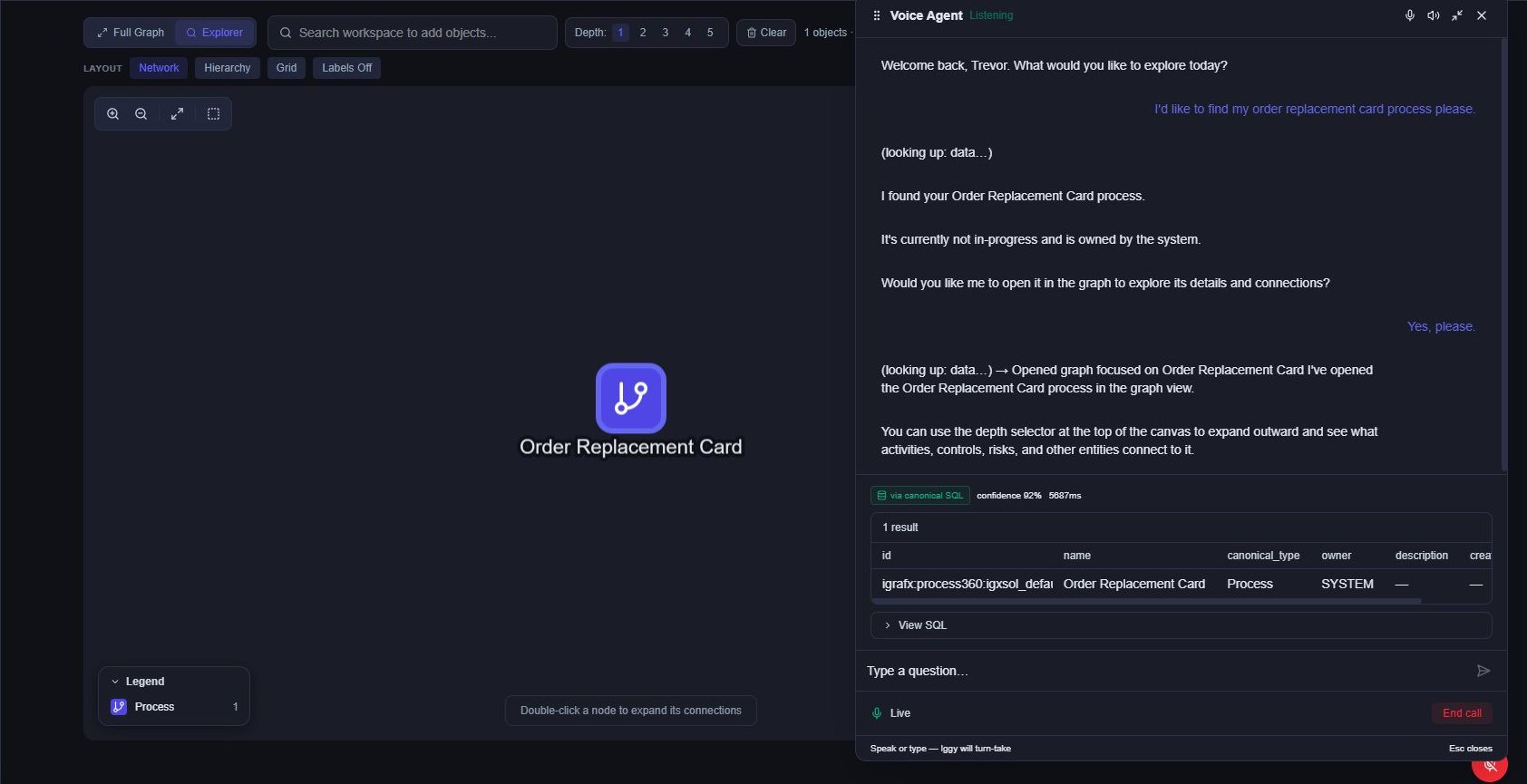
Your best improvements are
already visible in how work is designed.
How processes are designed, owned and connected shapes how they perform.
That design is already recorded in your models, standards and procedures.
Seeing it clearly shows where to simplify, align and improve first.
Greater operational clarity
and alignment.
IGX360 Insights works on your existing process knowledge to identify:
- Structural inconsistencies
- Process disconnects
- Duplication and fragmentation
- Governance gaps
- Automation opportunities
- Operational improvement priorities
Improve operational performance
Spot friction
Identify where process structures slow work down.
Improve consistency
Detect variability and standards drift across functions.
Prioritise improvements
Focus on highest-impact operational opportunities.
Increase alignment
Understand how processes connect across functions.
Get more from what you have
Draw greater insight from your existing process content.
Where operations teams apply IGX360 Insights
- Operational alignment initiatives
- Process harmonisation
- Governance improvement programmes
- Complexity reduction initiatives
- Process quality reviews
- Operational optimisation
Eight capabilities, one repository.
Every insight comes from the same canonical model: one place to look, queried through purpose-built lenses for your role.
Gap detection
Find missing, inconsistent or disconnected elements across the process knowledge you hold.
Standards insight
Measure adherence to your modelling standards, by unit.
Risk signals
Surface risk signals in how processes are structured and connected.
Compliance alignment
Check alignment with the standards you must meet, ahead of audits.
Automation insight
See where automation fits, and which steps are ready for it.
Nodal analytics
Understand dependencies, concentration and downstream impact.
Dashboards
Track current, previous and target states with role-based views.
AI interpretation
Turn what you hold into prioritised, decision-ready insight.
Better operations start
with clearer process insight.
Bring an area you want to improve. We will help you see where to start.